Improve Team Communication at Work: 6 Key Strategies


Summary
Your communication style says a lot about you as a leader. Are you supportive and relaxed as you guide your team through creative projects? Or are you more intense in your delivery, pushing your team members to work efficiently and create winning work? There are various communication styles, and failure to communicate effectively can cause low performance and morale.
Team communication is critical, but luckily, developing good team communication practices is easy. As a project manager, you can set the tone for how your team members communicate with one another. If you're currently struggling with communication, don't worry. Communication styles aren't set in stone, and in this article, we'll cover what team communication is, why it matters, and how your team can implement communication best practices.
Optimizing your tech stack for the AI era
From security risks to productivity loss, app sprawl may be costing you more than you think. Our latest guide reveals the true impact of an oversized tech stack and provides strategies to optimize your IT spend. Don't let hidden costs hold you back:
What is team communication?
Team communication is the exchange of information, ideas, and feedback among members of a group working toward shared goals. It encompasses every interaction your team has, whether through conversations, emails, video calls, or collaborative tools, and creates an environment where everyone feels heard and collaboration happens naturally.
Effective team communication includes:
Clarity: Sharing information in a way that's easy to understand
Consistency: Establishing norms, often through a communication plan, for how, when, and where your team communicates
Connection: Creating space for team members to share ideas and feel heard
Why is team communication important?
Strong communication is the driving force for everything you do at work. You can trace project quality, stakeholder relationships, and customer satisfaction back to how well your team communicates.
Good communication leads to effective decision-making, engaged team members, and successful projects. On the other hand, poor communication within your team may cause:
Imbalanced or duplicate work
Disappointing project results
Unsatisfied clients
Poor customer feedback
High team member turnover
High-stress environment
Low team member engagement
To improve team communication, you must lead by example. Be transparent with your team members, answer their questions, and provide context for your decisions. By creating a culture of open dialogue, you build a healthier work environment.
What are the 5 types of team communication?
Your team communicates in more ways than you might realize. Understanding all five forms of communication helps you build a high-performing team. Use this chart to identify where your team can improve.
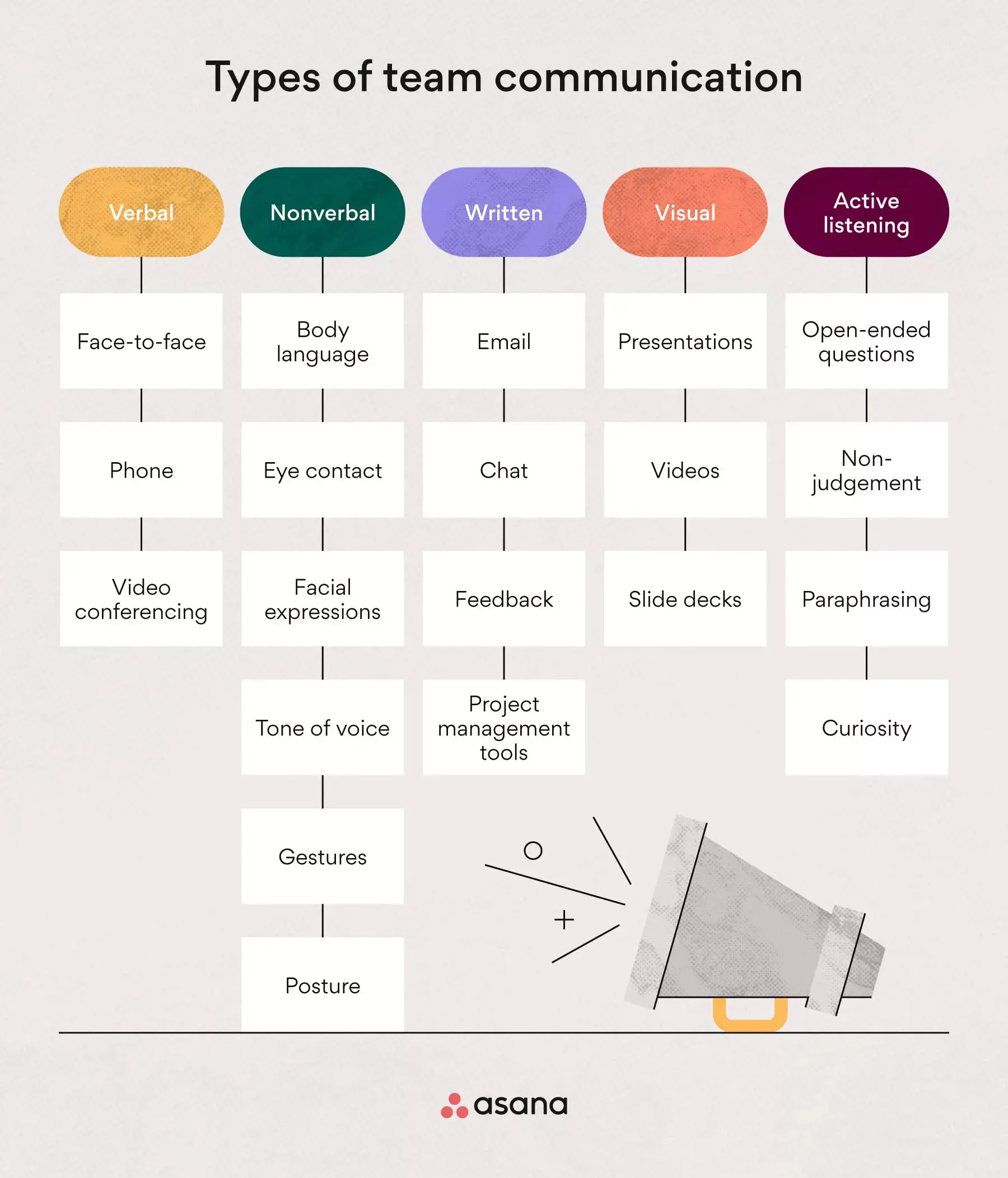
Verbal communication: It is the most important form of interaction between team members. Whether your team talks face to face, over the phone, or through video conferencing, these conversations can be the deciding factor in how one person perceives the other. Verbal communication provides the best opportunity for team members to express their thoughts.
Nonverbal communication: Nonverbal communication includes things like body language, facial expressions, and tone of voice. Many people aren't aware of how nonverbal communication affects their relationships. But in fact, more than half of all communication is nonverbal, which is why it's important to pay attention to nonverbal cues.
Written communication: You can easily control how you communicate through writing. Your team should have a common goal to communicate effectively through every written communication channel, including email, project management tools, messaging, surveys, or reviews. Knowing how to express yourself through writing can benefit your team and your audience.
Visual communication: It's important in team meetings or training when you're sharing information through slides or videos. The benefit of visuals is that you have time to think before you present your message to others. Before sharing, consider whether the visuals you've chosen will help your team understand what you're trying to communicate.
Listening: You may not think of listening as communicating, but effective communication can't occur without it. Listening is how you receive information when others speak to you. Active listening, in particular, creates a healthy work environment because it shows the communicator that you're engaged and paying attention to what they have to say.
6 strategies to build team communication skills
There are various strategies you can use to improve team communication in the workplace. Whether your team works remotely or in the office, these action steps will promote team collaboration and foster healthy relationships, regardless of position or rank.
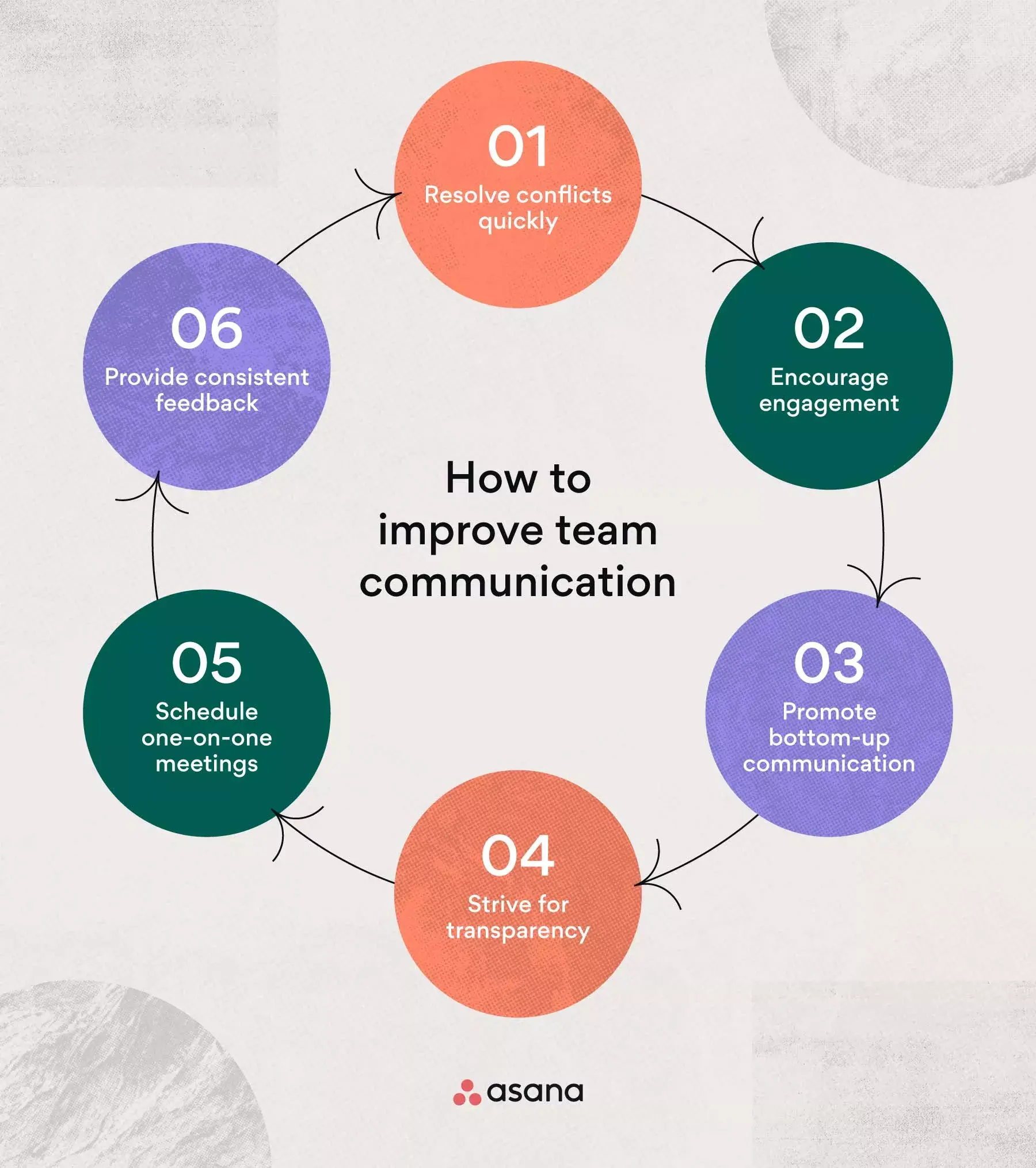
1. Resolve conflicts quickly
Conflicts at work can start small and seem inconsequential, but they escalate when left unaddressed. For example, if one team member repeatedly shifts deadlines without discussing the impact, the affected colleague may become resentful. When conflicts go unresolved, tension builds, and work performance suffers.
Tip: Teach team members conflict resolution strategies so they can address issues quickly, directly, and respectfully. That way, small problems don't turn into big ones.
2. Encourage engagement
No one likes to feel micromanaged, but without guidance or collaboration, team members can disengage. Your management style matters; encourage your team while giving them freedom to be creative.
Ways to boost engagement:
Host brainstorming sessions: Exchange ideas through workshops and team discussions
Show you value input: Ask for ideas and acknowledge each contribution
Build trust: Reassure team members that you support their creative thinking
Tip: Schedule weekly meetings so everyone can share what they're working on and ask questions if necessary. Meetings are a great way to engage your team without interrupting important focus time.
3. Promote bottom-up communication
Team members at the bottom of the team structure may not feel comfortable speaking up and sharing ideas. When you promote bottom-up communication, you encourage team members at every level to brainstorm ideas and share their opinions. You can promote this type of communication by building trust and morale with your team and giving them a sense of ownership in projects.
Tip: Team members may need a boost to feel comfortable speaking up. Ask them for their ideas, opinions, and feedback so they get used to sharing. Encourage team members across different environments, such as team meetings, surveys, one-on-one interactions, and a suggestion box.
4. Strive for transparency
A communicative workplace is one where team members prioritize transparency. When you and your team members are honest with one another, you reduce the risk of miscommunication.
How to be more transparent as a leader:
Share business performance: Disclose relevant information as it occurs
Provide constructive feedback: Help team members improve their skills
Connect work to goals: Show why their contributions matter to the big picture
Tip: There's a difference between transparency and oversharing. For example, it's helpful for your team members to know whether the company met its annual revenue goals, but you don't need to share your personal issues with the CEO this week. A team charter template can help you document those goals, outline responsibilities, and make it easier for everyone to stay on the same page as projects evolve.
5. Schedule one-on-one meetings
Team communication occurs in group settings and individual interactions. When team members connect one-on-one, they bring that positive energy back to the group.
Regular one-on-one meetings give you a chance to address issues and check in on your team members'well-being. Encourage your team to schedule one-on-ones with each other, too, so they can build collaborative relationships.
Tip: You don't need to take on the role of therapist as a manager, but you should care about how your team members are doing. If a team member is struggling emotionally, see if you can give them time off so they can come back to work in a healthier state.
6. Provide consistent feedback
An important part of team communication is performance feedback. Team members need reassurance about how they're doing to stay motivated and engaged. During your one-on-one meetings, give feedback to team members and discuss room for growth.
Tip: Team members may not always feel comfortable giving you direct feedback. Consider distributing an anonymous survey so you can get honest opinions from your team on your performance as team leader.
Read: 3 ways to collaborate remotely with your team4 team communication styles
Knowing how your team members communicate can help you manage your team as a whole. Understanding different leadership styles can also help you adapt your approach. The DiSC profile categorizes communication styles into four types: dominant, influencer, conscientious, or steady.
Your team members may have characteristics from more than one style, but understanding each person's primary style helps you tailor your communication and build a stronger team.
Style | Characteristics | Best approach |
Dominant | Intense, efficient, results-focused | Challenge them and keep goals in focus |
Influencer | Social, energetic, engaging | Give tasks that fit their strengths |
Conscientious | Detail-oriented, high achievers | Provide clear guidelines and feedback |
Steady | Values consistency and stability | Deliver changes incrementally |
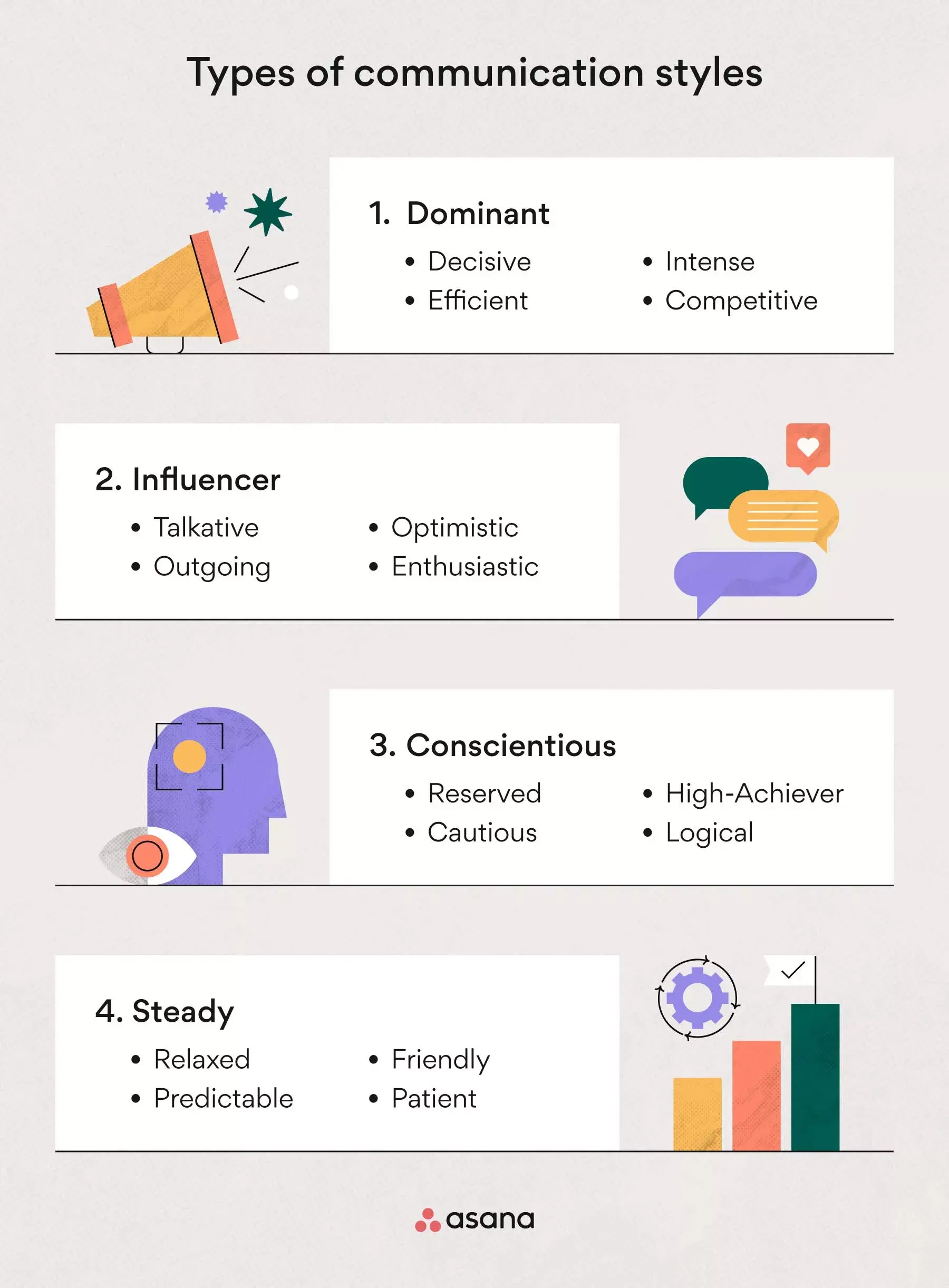
Dominant
Team members with dominant communication styles are intense, efficient, and results-oriented. You can usually spot these individuals because they're competitive and driven to succeed. While these individuals are natural team leaders, their weaknesses include impatience and excessive confidence.
Tip: Challenge dominant team members to feel motivated at work, but remind them to keep the team and company goals in focus at all times.
Influencer
Team members with influencer communication styles are the socializers of your group. These people know how to charm others and create an energetic and engaging environment. Your influencers will succeed at customer and client relations because they enjoy talking to people.
Tip: Keep influencer team members from losing focus by assigning tasks that fit their skill sets. Allow them to express themselves in their role while making sure they aren't a distraction to others.
Conscientious
Team members with conscientious communication styles are your high achievers. These team members work hard to produce error-free work and will go out of their way to grow their knowledge. A conscientious team member may prefer to work independently so they can control their performance.
Tip: These team members tend to prefer objective leadership, so there's no room for miscommunication. Allow conscientious team members to work on projects where they excel. Give them clear guidelines and measurable feedback.
Steady
Team members with steady communication styles value consistency and stability in their work environments. Unlike dominant team members who enjoy challenges, a steady team member may prefer a more predictable role in customer service or IT. A relaxed work environment allows team members with steady communication styles to feel comfortable and at peace.
Tip: Provide steady team members with a stable work environment. If changes occur, deliver them incrementally whenever possible. Actively listen to these team members so they feel heard and give them clear direction on any complex tasks.
Team communication tools that promote teamwork
Remote work is becoming increasingly common worldwide, which means much team communication occurs online. But even if you work in the office, you likely use team communication tools to share information and streamline your workflows.
There are team communication tools available for everything, including:
Messaging and chat: Use instant messaging and chat apps to discuss projects and ask questions in real time.
File sharing: File-sharing apps let you share documents without having to transfer them between team members.
Video conferencing: A great way to see your team members face-to-face when you're working from different locations or time zones.
Document editing: Online document editing allows you to share and save documents automatically. Your team can collaborate on documents because they'll remain viewable and editable to other team members.
Project management: You can't maintain strong communication with your team without a project management tool. Project management tools like Asana offer task management, goal setting, feedback, file sharing, and more.
When you can store, share, and refer to your work, your team will have more clarity in the workplace, and communication will become easier.
Better team communication starts with you
Better communication among team members requires you to lead by example. Your team members will speak up and become more engaged when you encourage them to do so. By taking responsibility for how you communicate and creating space for open dialogue, you set the foundation for a healthier, more connected workplace.
Team communication tools like Asana are designed for collaboration, and they can help you build healthy habits that lead to success. When your team has a central place to share updates, track progress, and collaborate on projects, communication becomes clearer and more consistent. Get started with Asana to see how better communication can transform the way your team works together.
Improve team communication with Asana