Team structure: 10 types to organize and align teams



Looking for ways to better organize and lead your team? You may be surprised to learn that there are many ways to achieve an organizational structure that improves team efficiency. A team structure defines the relationships between activities, leadership, and team members. Team structures can have a huge impact on the distribution of authority and how teams collaborate on a daily basis.
Each organizational structure has a different chain of command and offers unique ways to encourage teamwork through collaboration software. From a functional structure to a flat structure, we'll go over the 10 most effective ways to organize your team to help you find the right approach for your goals.
Optimizing your tech stack for the AI era
From security risks to productivity loss, app sprawl may be costing you more than you think. Our latest guide reveals the true impact of an oversized tech stack and provides strategies to optimize your IT spend. Don't let hidden costs hold you back:
What is a team structure?
A team structure is a way to define how roles and responsibilities and reporting relationships are organized within a team. It determines who reports to whom, how information flows, and how decisions are made at every level.
Key elements of a team structure include:
Reporting lines: Clear chains of command that establish accountability
Communication channels: Defined pathways for information to flow between team members
Decision-making authority: Guidelines for who can make which types of decisions
Team structures range from traditional hierarchies to flat organizations. The structure you choose shapes your team's culture, collaboration patterns, and adaptability.
Why team structure matters
Your team structure affects nearly every aspect of how your organization operates. A well-designed structure improves communication, speeds up decision-making, and keeps teams aligned. Without clarity, teams struggle with duplicate work and confusion about ownership.
Here are the key benefits of establishing a clear team structure:
Improved communication: Clear reporting lines and defined roles make it easier for team members to know who to contact and how information should flow.
Better decision-making: When authority and accountability are clearly assigned, decisions happen faster and with less friction.
Increased efficiency: Teams spend less time figuring out responsibilities and more time doing meaningful work.
Stronger accountability: Each team member understands what they own and how their work connects to team goals.
Scalability: A solid structure provides a foundation for growth, making it easier to onboard new team members and expand operations.
Whether you're building a new team or restructuring an existing one, choosing the right structure is one of the most important decisions you can make for your organization's success.
1. Hierarchical structure
A hierarchical format is the basis of most organizational charts. It organizes teams into a pyramid-like structure, with executives at the top and employees at the bottom. This is the most widely used structure because it creates clear boundaries and reporting lines.
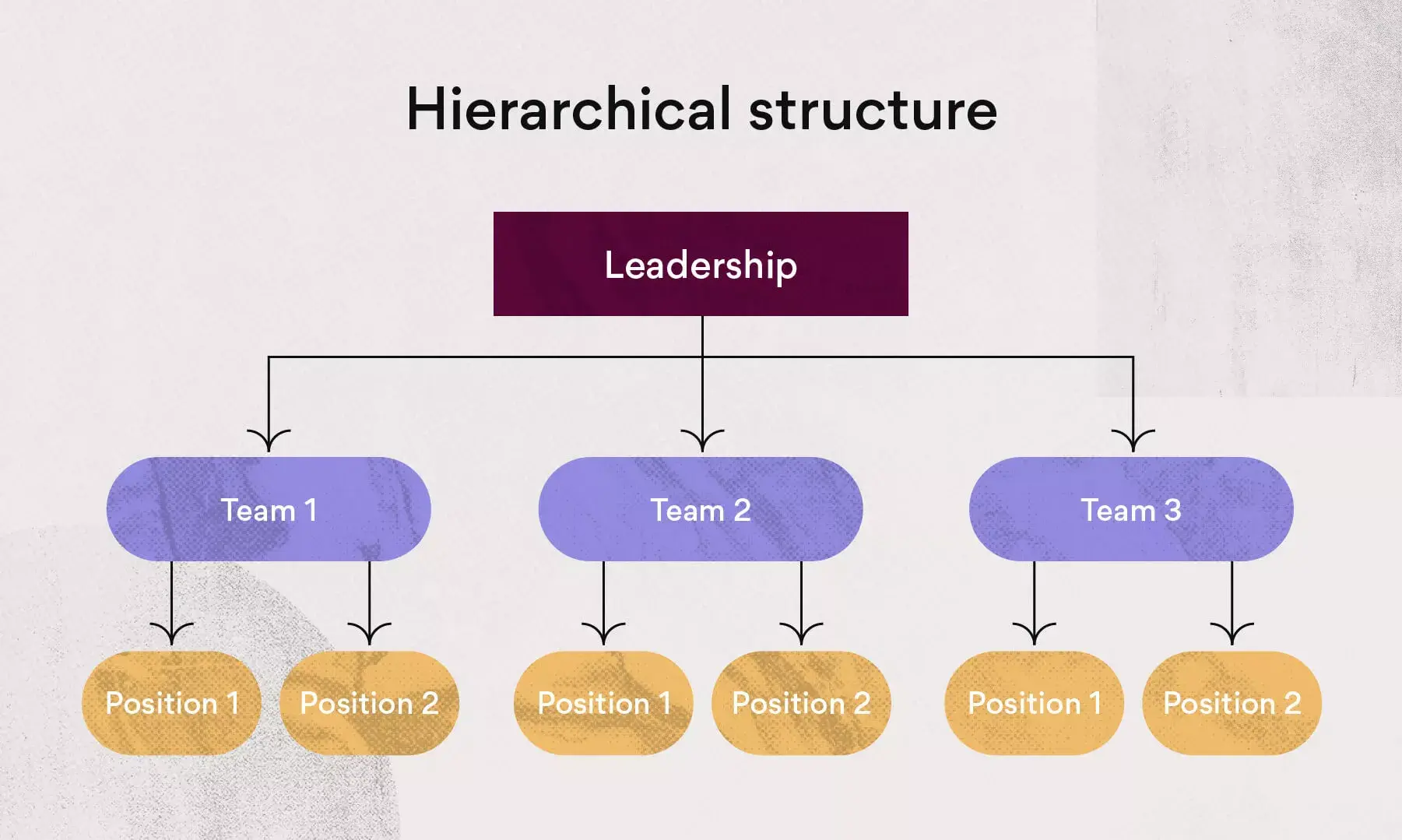
Many organizations use variations of the traditional hierarchy, including process-based and circular structures. The number of layers depends on your team's size and complexity, with most organizations having four or more layers visualized in a company-wide org chart.
Best for teams that are looking for:
A straightforward reporting structure
Clear career paths
Specialties within individual positions
Since this approach is a universal org structure, the hierarchical approach can work for most, if not all, teams.
No more silos: Optimizing your organizational structure for stronger cross-team collaboration
In this ebook, learn how to structure your organization to prevent silos, move faster, and stay aligned in the face of change.


2. Functional structure
The functional organizational structure groups teams by skill and knowledge. Each department is vertically structured from top management down to individual team members, with a single authority overseeing each department.
While these teams will vary from company to company, the purpose of the functional structure is to support specialized skills and prepare for organizational growth.
Best for teams that are looking for:
Field experts
Team accountability
Organizational growth
A key feature of the functional structure is the ability to cultivate niche specialties within different departments.
3. Matrix structure
The matrix structure differs from typical hierarchical models. Team members report to more than one leader in a grid format, typically having both a primary manager and a project or functional lead.
Matrix organizations use this structure to balance leadership and decision-making. The main benefit is creating a balanced organizational structure by establishing reporting lines to multiple leaders in different departments.
Best for teams that are looking for:
A balance between units and products
Improved collaboration and communication
Fluid balance in leadership
This works for teams that want team members to feel empowered to make decisions rather than limiting authority to a handful of individuals.
Read: 12 tips to effective communication in the workplace4. Process-based structure
A process-based structure emphasizes different internal processes rather than departments. It's organized by hierarchy with leadership connected to these various processes.
This type of team structure is preferred by organizations whose processes take precedence over individual projects. These may be new processes or processes your organization has already implemented.
Best for teams that are looking for:
Efficiency
Organizational growth
Assistance with many different processes
Teams suited to this structure tend to focus on internal processes and efficiency rather than on external-facing projects.
5. Circular structure
While visually different, the circular structure follows a hierarchical organization, as do most others. Higher-level team members are represented in the inner circle, and lower-level team members occupy the outer circles. Executive leadership is shown in the center, representing the fluid relationship they have with each department head.
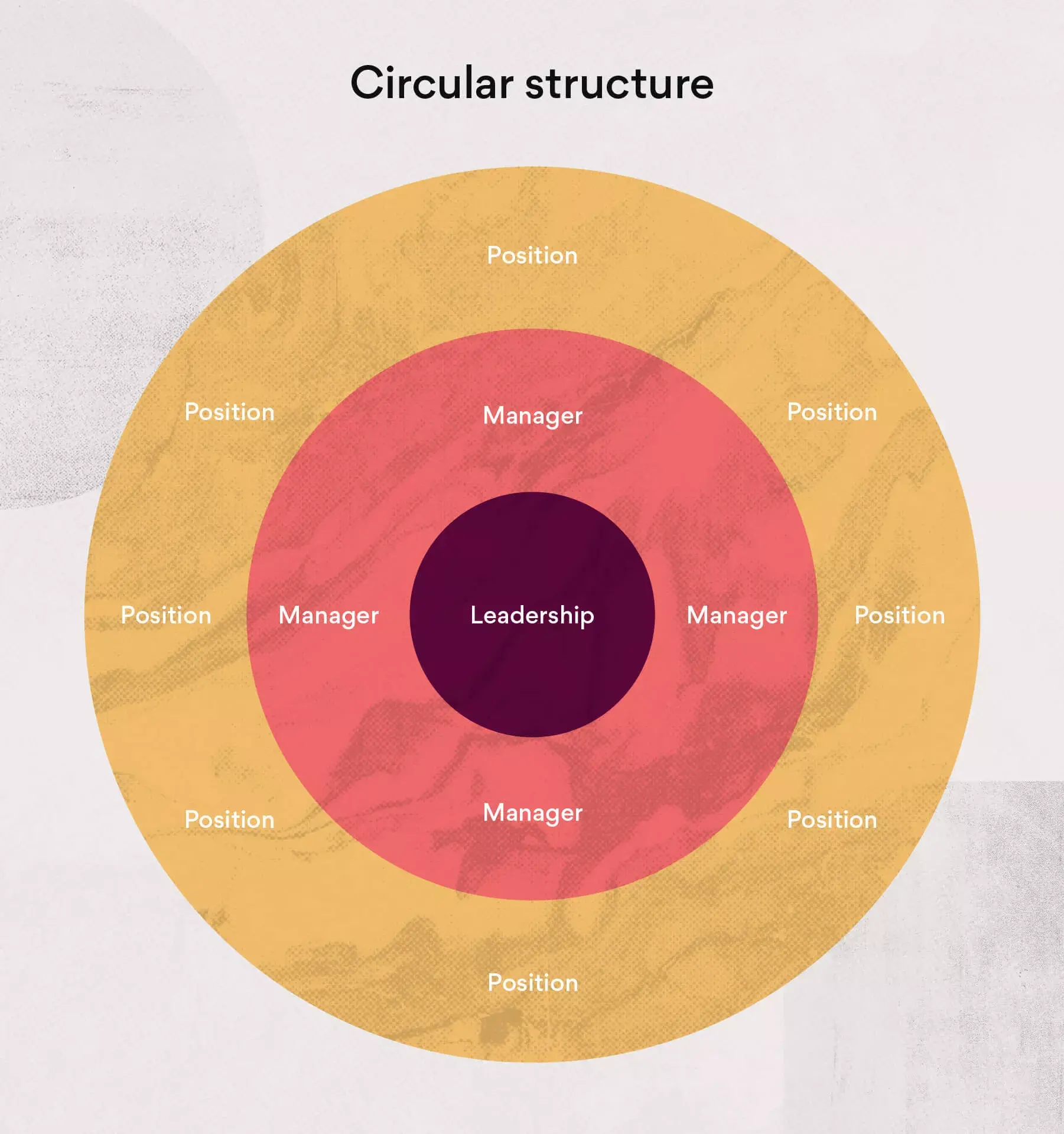
This full-circle organizational structure keeps everyone connected while allowing them to remain separate in their own circles. The number of rings increases until all individuals are assigned to their appropriate levels.
Best for teams that are looking for:
Streamlined communication
Easy flow of information
Fluid relationships
This modern approach can work well for remote organizations that need help effectively communicating between leadership and team members.
Read: Improving team effectiveness: 4 models to guide you6. Flat structure
A flat structure minimizes the levels between leadership and individual teams. Unlike hierarchical approaches with many management layers, flat structures have only a couple of steps between executives and team members. This creates a more interconnected web rather than a traditional pyramid.
The flat structure is great for teams that want to create centralized or unified networks that align with common goals. The main objective is to create a balance between leadership and cross-functional teams.
Best for teams that are looking for:
Higher productivity
Aligned goals
Organizational clarity
If you're willing to take a nontraditional approach, the flat method can have a tremendous impact on productivity and clarity.
Read: How a deal desk can improve your sales flowNo more silos: Optimizing your organizational structure for stronger cross-team collaboration
In this ebook, learn how to structure your organization to prevent silos, move faster, and stay aligned in the face of change.
7. Network organizational structure
In a network organizational structure, teams are organized around their respective networks. This is well-suited for organizations that require work to be done by external teams, have various global locations, or own multiple small businesses.
Each network is organized as a separate entity, connected to the others via hubs. Separating teams into hubs allows more information to be shared within networks because team members know the appropriate person to contact.
Best for teams that are looking for:
Communication within networks
Clear contact information
Specialties within networks
The network structure is most commonly used out of necessity when teams are already arranged into networks of some kind.
8. Product-focused divisional structure
A divisional structure groups each function into a separate division. Within this type of structure, there are a variety of specialized areas, including a product-focused structure.
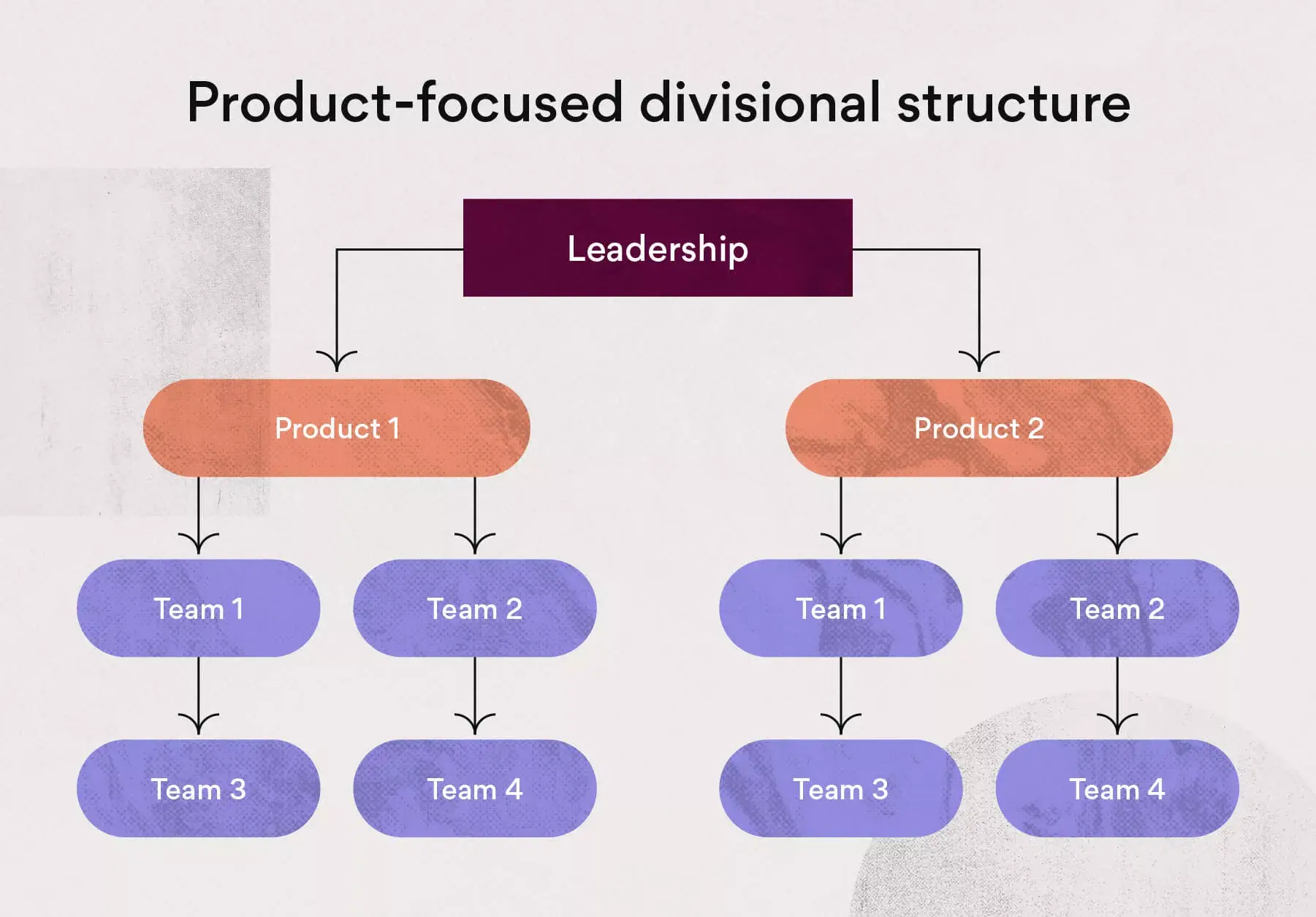
Each division is divided into individual product lines, with select teams responsible for each. This is helpful for organizations that revolve heavily around production and want to establish clear cross-departmental responsibilities.
Best for teams that are looking for:
Semi-autonomous divisions
Continuous product improvements
These features are best for teams heavily involved in product development who prefer a balance between individual work and teamwork.
9. Market-focused divisional structure
A market-focused division focuses on individual markets, from different industry types to customer types. Organizations that use this structure may have multiple brands under a single umbrella company or offer vastly different goods and services.
This type of divisional structure creates clear responsibilities for specific departments. Companies that use this structure usually have a wide array of products and need help organizing departments across their product lines.
Best for teams that are looking for:
The ability to focus on one market at a time
Team specialization
Individual accomplishments
A market-focused structure is best for teams that prefer a balance of both individual work and teamwork.
10. Geographical divisional structure
The final divisional structure type focuses on geographical areas. Regions, territories, or districts are organized into separate divisions, creating clear boundaries and logistics across geographies. This structure is best for organizations that rely on customers or supply chain needs within specific regions.
Dividing work can positively affect a variety of functions, including individual specialization and increased value in select geographical locations.
Best for teams that are looking for:
The ability to serve local communities
Communication with local customers or supply chain facilities
Team collaboration
This divisional structure is typically used out of necessity. It's ideal for organizations with multiple physical locations or team members spread across different regions.
Which team structure is right for you?
The right team structure depends on your team's size, leadership style, and company values. The key factors to consider are communication flow and leadership balance.
Structure Type | Best For | Communication Style |
Hierarchical | Large organizations needing clear reporting | Top-down |
Functional | Teams requiring specialized expertise | Within departments |
Matrix | Cross-functional projects | Multi-directional |
Flat | Startups and agile teams | Open and direct |
Network | Distributed or outsourced work | Hub-based |
Team structures and communication
When it comes to communication within an organization, there is a balance between too much and too little. Overcommunication can cause confusion and employee burnout. Too little communication can result in duplicate work and low productivity.
Team structures that embody balanced communication and clarity include:
The matrix structure
The circular structure
The network structure
These types of structures can be used for development teams, marketing teams, and most others in between.
Team structures and leadership
The relationship between leadership and team members is equally crucial. Large gaps between upper- and lower-level employees can create confusion and communication issues.
Finding a balance can be tough. Those in leadership roles should have authority over areas with broad organizational impact, but limiting authority to a few individuals can feel disempowering.
Team structures that create a balance of leadership authority include:
The flat structure
The matrix structure
The hierarchical structure
The right authority structure will help empower your team to contribute ideas and deliver work that makes an impact.
Read: Leadership vs. management: What’s the difference?Structure your team for success
Your team's structure affects everything from team building to employee morale and business success. As a project manager, creating clear boundaries helps improve productivity and performance.
Key takeaways:
Choose a structure that matches your team's size, goals, and communication needs
Balance leadership authority with team empowerment
Revisit your structure as your organization evolves
Ready to put your team structure into action? Get started with Asana to organize teams, clarify roles, and keep everyone aligned on goals.
No more silos: Optimizing your organizational structure for stronger cross-team collaboration
In this ebook, learn how to structure your organization to prevent silos, move faster, and stay aligned in the face of change.