Scope management plan: Process, components, template



Summary
Managing the scope of a project is like driving a car; if you don't keep your eyes on the road, the car veers off. Similarly, if you don't control your project scope, it can get off track. A scope management plan outlines the processes for executing your project and keeps it within defined limits.
As a project manager, it's your responsibility to guide your team through the project life cycle. In this article, we'll cover what a scope management plan is, its key components, how to create one, and tips for avoiding common challenges.
How to build a transformational AI strategy from the ground up
The journey of AI adoption is no longer uncharted territory. Supported by research from our Work Innovation Lab in partnership with frontier AI safety and research company, Anthropic, this guide offers a how-to for navigating the journey of AI adoption.
What is project scope management?
Project scope management is the process of defining, controlling, and monitoring what is and isn't included in a project. It ensures that project goals, tasks, deadlines, and costs stay aligned with objectives. A well-defined scope management plan prevents scope creep, keeps resources focused, and keeps your project on track.
Phases of project scope management
Effective project scope management involves several key steps: initiating, planning, defining, verifying, and controlling the project scope. By adhering to these steps, project managers can create a detailed project scope management plan that outlines how the scope will be defined, validated, and controlled throughout the project lifecycle.
This plan is a roadmap for stakeholders to understand the project's boundaries and helps keep everyone on the same page from start to finish.
1. Initiation
The initiation phase sets the groundwork by identifying the part of the project that needs focus and the primary objectives. During this phase, you engage key stakeholders, assess project feasibility, and develop a clear statement of work or project charter. The initiation phase creates a solid foundation for all subsequent project activities.
2. Planning
During the planning stage, the project team collaborates to develop a comprehensive approach that outlines the project timeline, scope baseline, and project budget. This is where the scope definition becomes crucial. It's the process of breaking the project into manageable tasks and subtasks, making it easier for the team to meet expectations.
3. Defining
In the defining stage, you create precise documentation of the project's exclusions, clarifying what is outside the project's scope to prevent misunderstandings and scope creep. This documentation provides a clear reference for what the project will deliver. All project stakeholders and team members gain a cohesive understanding of the project objectives.
4. Verification
Verification involves regular reviews with project stakeholders to confirm that the project remains aligned with the scope baseline and to make necessary adjustments. Verification is vital for managing changes and avoiding scope creep, which can derail project success.
5. Controlling the project scope
Finally, controlling the project scope requires continuous monitoring and management of the project's progress against the original plan. This entails monitoring the project team's performance, controlling the project budget, and managing cost overruns. Ensure all stakeholders are aware of and agree to any changes to the project timeline.
Importance of project scope management
Understanding the importance of scope management is pivotal to managing project constraints and avoiding pitfalls such as delays, budget overruns, and stakeholder dissatisfaction. A well-crafted project scope management plan serves as a blueprint that guides every decision and action across the project.
For example, consider a project to develop new customer service software. When a stakeholder suggests a feature not originally included in the scope, the project manager can refer to the project scope management plan to firmly explain why the new feature cannot be accommodated. This decisive stance ensures the project remains focused and on track.
Read: 7 important steps of the decision-making processWhat is project scope?
Your project scope sets the boundaries of your project and defines its goals, deadlines, and deliverables. When you clarify your project scope, you're structuring your project around what your team will and won't do. You're also providing goals and objectives for them to work toward.
The entire team should be involved in defining the project scope. This means communicating with key stakeholders and drafting a project scope statement that outlines the project's requirements. For example, if you're defining the scope for a new advertising campaign, you'll want to ensure the design, content, and digital marketing teams all agree on the details in the scope statement.
What is the purpose of a scope management plan?
The purpose of a scope management plan is to create a project structure by documenting the resources required to achieve the project objectives. It also reduces the chance of scope creep.
A scope management process helps you avoid common problems, including:
Constantly changing requirements: A clear scope prevents stakeholders from adding new requests mid-project.
Overspending: Defined boundaries help you stick to your budget.
Wasted time: Teams stay focused on approved work instead of unplanned tasks.
Failure to meet deadlines: Controlled scope keeps your timeline realistic.
What is scope creep?
Scope creep occurs when your project exceeds your initial scope statement. For example, scope creep may occur if a stakeholder adds an additional project deliverable after the project has begun.

Unexpected project changes can increase project risks, such as missed timelines, budget overruns, overwork, or a low-quality end product. There are various reasons why scope creep can occur, including:
Unclear project scope
Unrealistic project objectives
Too many stakeholders
Poor scope management
Poor communication with stakeholders
To avoid scope creep, you need to plan against it, which is where a strong scope management plan comes into play.
Key components of a scope management plan
A comprehensive scope management plan includes four essential components that work together to define, monitor, and control your project scope. Understanding these components helps you build a plan that keeps your project on track.
Component | Purpose |
Project scope statement | Defines what is and isn't included in the project |
Work breakdown structure (WBS) | Breaks the project into manageable tasks |
Scope baseline | Serves as a benchmark to measure performance |
Scope verification and change control | Manages deliverable acceptance and scope changes |
Project scope statement
The project scope statement is a detailed description of what your project will deliver. It outlines the project objectives, deliverables, boundaries, and acceptance criteria. This document serves as the foundation for all scope-related decisions and helps stakeholders understand exactly what the project includes and excludes.
Work breakdown structure (WBS)
The work breakdown structure breaks your project into smaller, manageable components. By decomposing the project scope into work packages, you can better estimate costs, assign resources, and track progress. The WBS provides a visual representation of all the work required to complete the project.
Scope baseline
The scope baseline combines your approved scope statement, WBS, and WBS dictionary into a single reference point. This baseline serves as the benchmark against which you measure project performance. Any changes to the scope must be compared against this baseline to assess their impact.
Scope verification and change control process
Scope verification ensures that deliverables meet the defined acceptance criteria, while the change control process establishes how scope changes will be requested, evaluated, and approved or rejected. Together, these processes help you maintain control over the project scope throughout its lifecycle.
How to create a project scope management plan
The Project Management Institute's (PMI) Project Management Body of Knowledge (PMBOK® Guide) offers a standard, six-step project scope management process. These six steps help you create a solid scope management plan to keep your project on track.
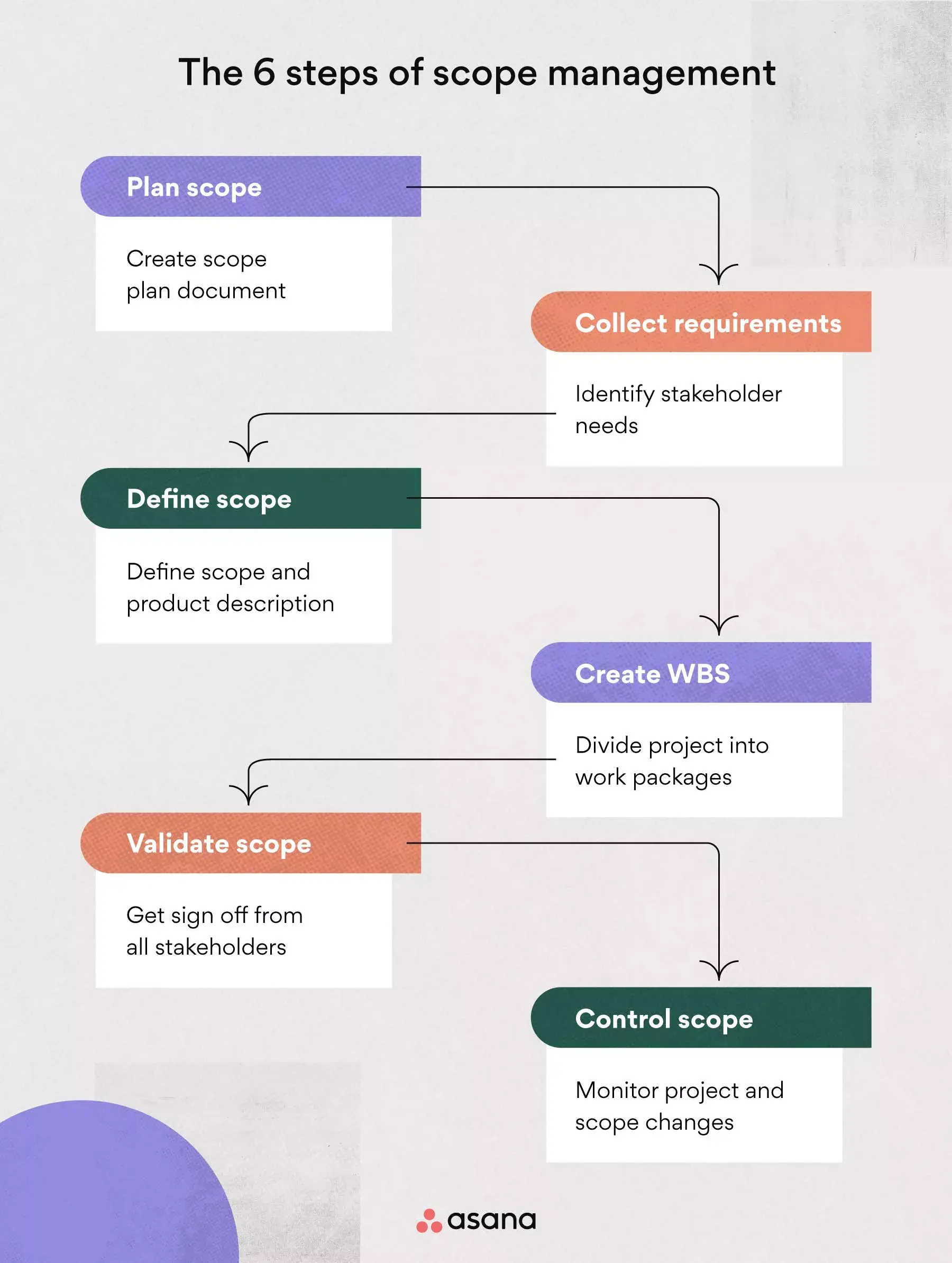
1. Create your scope plan
The first step in the planning process involves creating your scope plan document. This document should include:
Your scope statement
A breakdown of project requirements
Expected deliverables for the project
Your scope plan document may also include a change control process to manage change requests and prevent scope creep. This document is especially useful for complex projects, projects with many stakeholders, or when deliverables are still in flux.
Tips for creating a scope plan:
Incorporate expert judgment: Check in with cross-functional and executive stakeholders to ensure you have all the information you need.
Hold scope kickoff meetings: Before locking your scope document, share it asynchronously or host a kickoff meeting to gain buy-in from all stakeholders.
2. Collect project requirements
In this step of the process, you'll identify stakeholders'needs so you can meet project objectives. Your goal should be to apply thorough requirements gathering techniques with stakeholders so that you can prevent scope changes down the line.
Tips for collecting project requirements:
Create a project charter: Create a project charter, or an elevator pitch, so stakeholders can clearly understand the project and ensure their expectations match the project's objectives.
Conduct focus groups or workshops: Provide stakeholders with a better understanding of your project. Communicating your project objectives to stakeholders is essential if you want them to buy into your project scope.
Develop prototypes: Create a prototype of your project deliverable before presenting it to stakeholders. This way, stakeholders can visualize the end product, voice their concerns, or list additional requirements early on.
3. Define scope
Once you've collected requirements from stakeholders, turn that information into a well-defined scope and a detailed product description. This document clarifies the project's expectations and deliverables, ensuring all team members know what they must accomplish.
Tips for defining scope:
Try a product analysis: view the product you plan to create through the eyes of the customer or client to determine whether it will meet their expectations.
Generate alternatives: You'll also want to generate alternatives in case your project encounters risks. For example, how will you meet stakeholder needs if your launch date gets delayed?
Facilitate workshops: Host brainstorming sessions to clarify the project's scope and encourage collaboration among team members.
4. Create a work breakdown structure
A work breakdown structure (WBS) is a way to divide your project into levels of tasks. When you create a WBS, your team can clearly visualize each project component and assess what needs to be done.
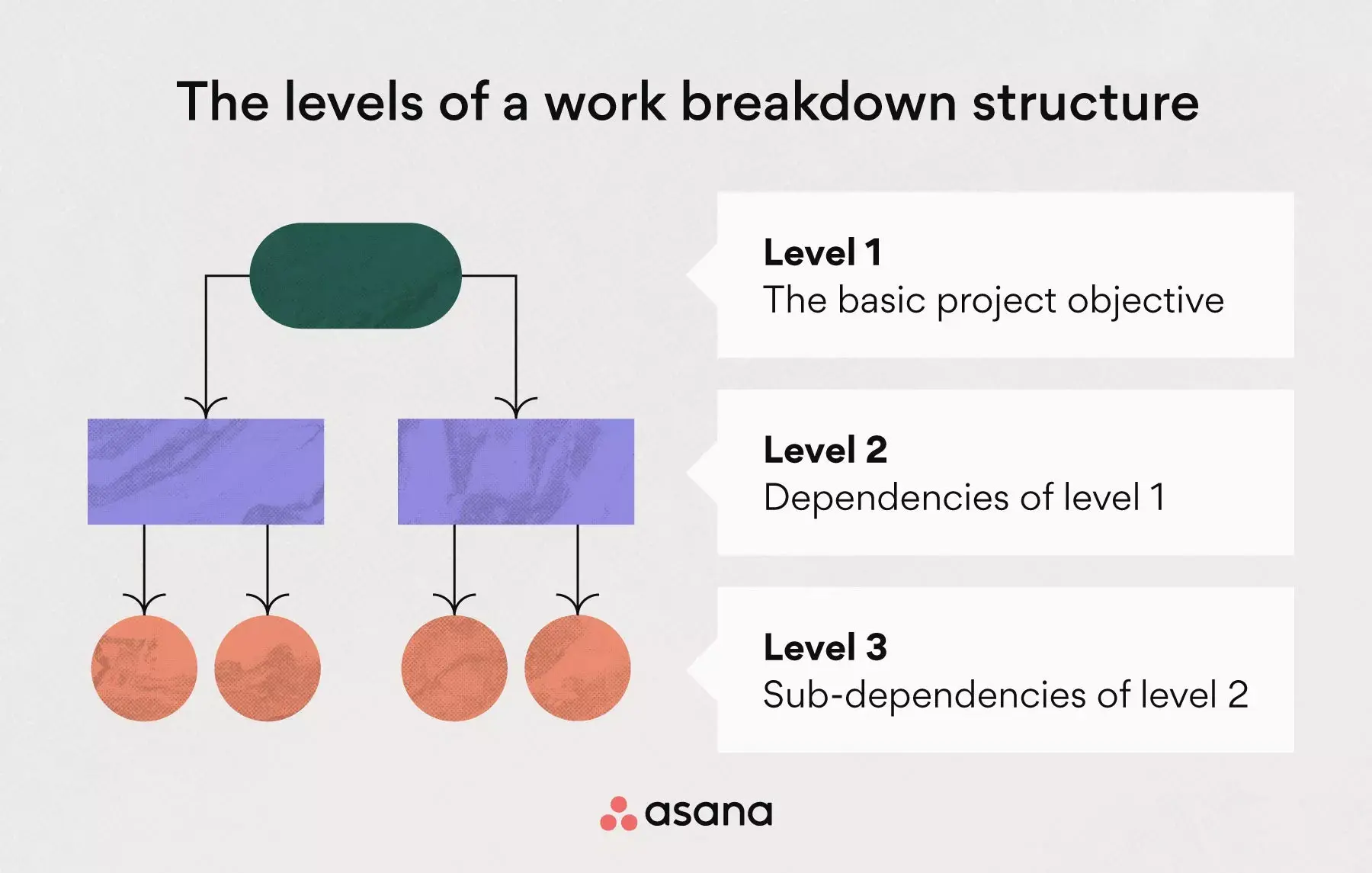
A work breakdown structure creates a hierarchical structure of tasks. From there, you can schedule, monitor, and control your project. You can save time by starting with a work breakdown structure template, which provides a consistent way to map every project task.
Tips for creating a WBS:
Decompose your project objective: A WBS breaks it down into dependencies and sub-dependencies, often called work packages. Once you break your tasks down, you have clear insight into everything your project needs, including the hours, equipment, tools, and expenses.
Automate workflows: Automating team member workflows can streamline project coordination and improve project visibility. Using software to automate these workflows will also reduce manual information-gathering and duplicative work.
5. Validate scope
Validating your scope simply means getting sign-off from all stakeholders involved in the project. Make sure stakeholders clearly understand your project deliverables to avoid future scope creep. If possible, get feedback or advice on any changes and improvements.
Tips to validate scope:
Inspect your plan: Because validation is the final sign-off for your scope management plan, you'll want to review and inspect it thoroughly. Team members and stakeholders should both participate in a final inspection so that the plan gets as many eyes on it as possible.
6. Control scope
The last step in your scope management plan is scope control. As your project continues into the execution phase, monitor the status of the project and manage changes to the scope. The best way to streamline scope control is to use project management software that allows real-time sharing of feedback, files, and status updates.
Tips to control scope:
Analyze variance: Assess the extent of scope variance. Analyzing the actual performance of your scope versus the planned performance will give you insight for future projects.
Refer to the change control document: You created a change control process earlier in the planning phase. Remember to refer to this document to track the flow of information regarding project changes.
Common challenges in scope management
Even with a solid scope management plan in place, project managers often face challenges that can derail their projects. Recognizing these obstacles early helps you prepare effective strategies to address them.
Vague requirements
When project requirements aren't clearly defined from the start, teams struggle to understand what they need to deliver. Without proper requirements management, vague requirements lead to misinterpretation, rework, and scope disputes.
Solution: Involve stakeholders early and document specific, measurable requirements.
Uncontrolled changes
Without a formal change control process, scope changes can slip into your project unnoticed. These uncontrolled changes accumulate over time, leading to budget overruns and missed deadlines.
Solution: Establish clear procedures for submitting, reviewing, and approving all change requests.
Misaligned stakeholder expectations
Different stakeholders often have varying expectations about what the project will deliver. When these expectations aren't aligned early, conflicts arise later in the project lifecycle.
Solution: Use regular communication and documented agreements to keep everyone on the same page.
Lack of visibility
When team members and stakeholders can't see the current state of the project scope, they make decisions based on incomplete information. This leads to duplicated efforts, missed tasks, and poor resource allocation.
Solution: Use project status reports and centralized project management tools to improve transparency.
Tips for effective project scope management
Effective project scope management is crucial for the success of any project. It combines strategic planning and work management techniques to ensure that objectives are met efficiently.
Here are several tips to guide you in keeping your project on the right path from start to finish:
Clearly define the product and project scope. Begin with a precise definition of both the product scope, detailing the features and functions of the product or service being developed, and the project scope, which includes the work required to deliver the product. A clear distinction between these scopes helps prevent misunderstandings and scope creep.
Engage stakeholders early. Involve key project stakeholders early in the planning process using a stakeholder engagement plan. Their input can help refine the project scope and ensure it aligns with business objectives and stakeholder expectations.
Develop a detailed scope management plan. Create a comprehensive scope management plan that outlines how scope changes will be identified, evaluated, and implemented or rejected. This plan is your roadmap for navigating scope challenges.
Implement change control processes. Establish formal change control processes to manage requests for changes to the project scope efficiently. These processes help assess the impact of changes on the project timeline, budget, and resources.
Document everything. Keep detailed records of all project meetings, decisions, and changes related to the project scope. Documentation provides a clear reference point for all project participants and can be invaluable for resolving disputes and informing future projects.
Incorporating these tips into your project management practices can lead to more successful outcomes. Effective scope management is about balancing the detailed planning of product features and project work with the flexibility to adapt to changes.
Simplify scope management with the right tools
A project scope management plan creates a clear structure for your team to follow during project execution. Scope management planning is easier when you use an online tool, as you can share your plan with stakeholders, automate internal workflows, and easily break project objectives into tasks.
Ready to take control of your project scope? Get started with Asana to keep your projects on track, prevent scope creep, and help your team deliver their best work.
Create a scope management plan template