Release management process: 5 phases & best practices



If you've ever experienced a software release, you know just how complicated things can get. From managing project timelines to tracking due dates and scope, it's a lot for one person to handle. That's where release management comes in. With the right process in place, you'll be able to manage even the most complicated of tasks.
Release management is a technique for planning, managing, and controlling software updates to improve quality, speed, and efficiency. We'll go over what a release management process includes in more detail and provide a checklist to help you get started with your own release plan.
Master AI-Powered Workflow Optimization
Ready to revolutionize your team's productivity with AI you can trust? Join industry leaders from Asana and Anthropic to learn proven strategies for implementing AI across your workflow stages and unlock the full potential of Asana's AI Studio.
What is release management?
Release management is the process of planning, scheduling, and controlling software updates through development, testing, and deployment stages to ensure reliable, high-quality releases. It gives your team the structure and information needed to launch successfully
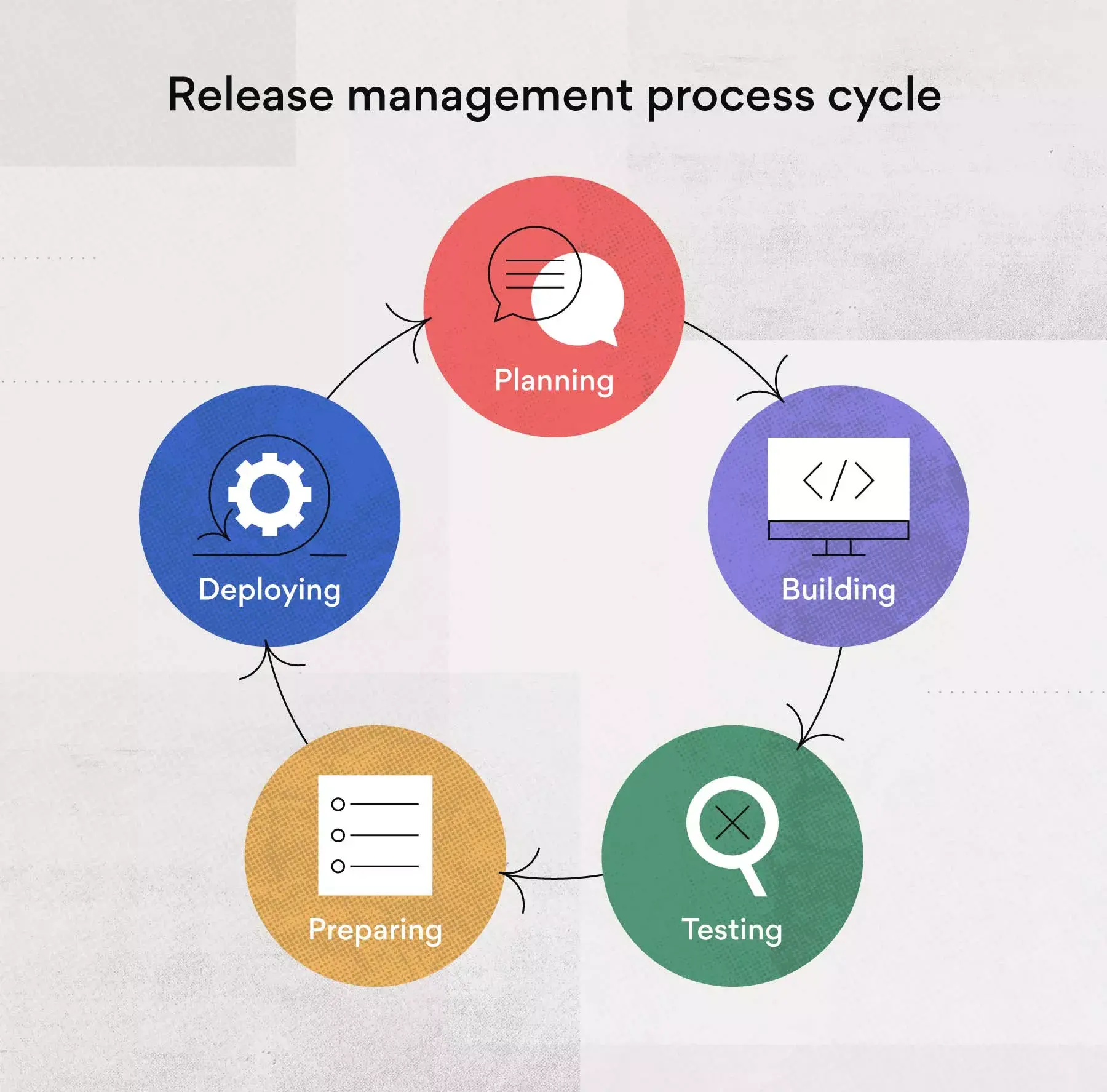
The release management lifecycle consists of five steps: planning, building, testing, preparing, and deploying a software update. Each stage is important for properly organizing and executing a successful release.
Why release management matters
Without a structured approach to releases, teams often face delays, miscommunication, and costly errors. A solid release management process helps your organization in several key ways:
Reduced risk: By following consistent steps and building in testing phases, you strengthen your risk mitigation efforts and minimize the chance of deploying faulty code to production.
Faster time-to-market: Streamlined processes and clear handoffs reduce lead time, helping your team ship features and updates more quickly.
Improved software quality: Structured testing and review stages help catch bugs before they reach end users.
Better team collaboration: When everyone understands the release process, development, operations, and stakeholders can work together more effectively.
Scalability: As your organization grows, a repeatable release process ensures you can handle increased complexity without sacrificing quality.
Continuous improvement: Built-in feedback loops allow your team to learn from each release and refine the process over time.
When your team has a clear release management strategy, you spend less time firefighting and more time delivering value to your customers.
What are the 5 phases of the release management process?
The five phases of release management are planning, building, testing, preparing, and deployment. Each phase plays a critical role in delivering software updates that are efficient, safe, and error-free.
Read: A 6-step guide to requirements gathering for project success1. Release planning
The first step in launching software is to kick off planning with your development team's stakeholders. While there are several ways to approach this step, common initiatives include holding an initial meeting, writing a business case, and creating a work breakdown structure to outline project dependencies.
Each of these tasks will help you, the release manager, complete a system development lifecycle. In the planning phase, you should also connect with operations teams and leadership to secure approval for the software build and ensure it is ready for development.
Here's a release management planning checklist to use when starting this process:
Connect with stakeholders: Create a project summary report and send it out in advance for them to review before your initial meeting.
Run an initial project kickoff meeting: Outline key details about the project, including the objective and success metrics.
Write a business case: Explain the value of the project and the impact it will have on your organization, along with long-term benefits.
Create a work breakdown structure: Visualize your project by breaking dependencies into small, easy-to-understand tasks.
Submit software for approval: Get stakeholder approval and make project changes before your team gets started.
Plan your release schedule: Map, assign, and track project tasks in order to keep the software release moving forward.
Once you've completed this checklist, you're ready for the next stage: building the software.
2. Release building
Step two is the most time-intensive phase, as team members begin developing the software. Tasks should be assigned to stakeholders, and project information should already be communicated. As the team builds the software, they should test and improve features simultaneously. Track any potential risks or bugs early so you're prepared for the formal testing phase.
Here's a release management building checklist to use when starting this process:
Assign tasks to stakeholders
Complete project dependencies
Document software risks using a risk register
Use teamwork to problem solve
Roll out new features within a production environment
Automate initial testing
While teamwork and testing are necessary during software development, the real testing will begin in the next phase.
3. Release testing
The testing phase ensures your software runs properly and is ready for launch. It's helpful to have team members identify and resolve bugs as they arise, but it's also important to begin user testing at this step. While this will depend on how complex your software release is, user testing is an opportunity for consumers to test your software, often in exchange for a reward.
You'll also want to perform regression testing, which involves double-checking already-approved functionality to ensure it's still working correctly. Here's a release management testing checklist to use when starting this process:
Begin end-user acceptance testing (UAT)
Resolve or mitigate software risks
Identify software bugs
Perform regression testing
In software, testing is a major part of any release plan and can be time-consuming if numerous changes are required.
4. Release preparation
During the preparation stage, your team completes the necessary changes and optimizes functionality in the staging environment. This ensures every part of the software is ready to go live. Run a final quality assurance check, or multiple checks, to verify all functionality works properly. Include team members who weren't involved in development, as they'll bring fresh eyes to the review.
Here's a release management preparation checklist to use when starting this process:
Replicate each software scenario
Optimize software integrations
Solve software bugs
Final QA
Once you have given the software a final review and it's been approved, you can begin deploying it in a live environment.
5. Release deployment
The final phase of a software release involves deployment management. This is the process of transforming the initial software idea into a functional product and includes moving the features into a live environment. To deploy the software release, additional testing is necessary to ensure functionality remains intact in the live environment. Once that's done, it's advisable to continuously monitor integrations and implement necessary changes to enhance functionality.
Here's a release management deployment checklist to use when starting this process:
Deploy in a live environment
Test in a live environment
Analyze key performance indicators (KPI)
Employ continuous integrations
It's also a good idea to close project tasks once the software is live and any needed changes to integrations have been made.
Create your release management templateRelease management vs. change management
While release management and change management share similarities, they serve different purposes. Release management focuses on delivering software products, while change management coordinates project or business changes using a change control process.
Aspect | Release management | Change management |
Primary focus | Deploying software updates | Coordinating project changes |
Key activities | Configuring, planning, releasing, testing | Assessing, authorizing, requesting, reviewing |
Timing | Planning and scheduling before execution | Coordinating changes during execution |
Now that you understand what release management is and how it differs from change management, let's look at which methodology is right for you.
Read: What is change management? 6 steps to build a successful change management processRelease management methods
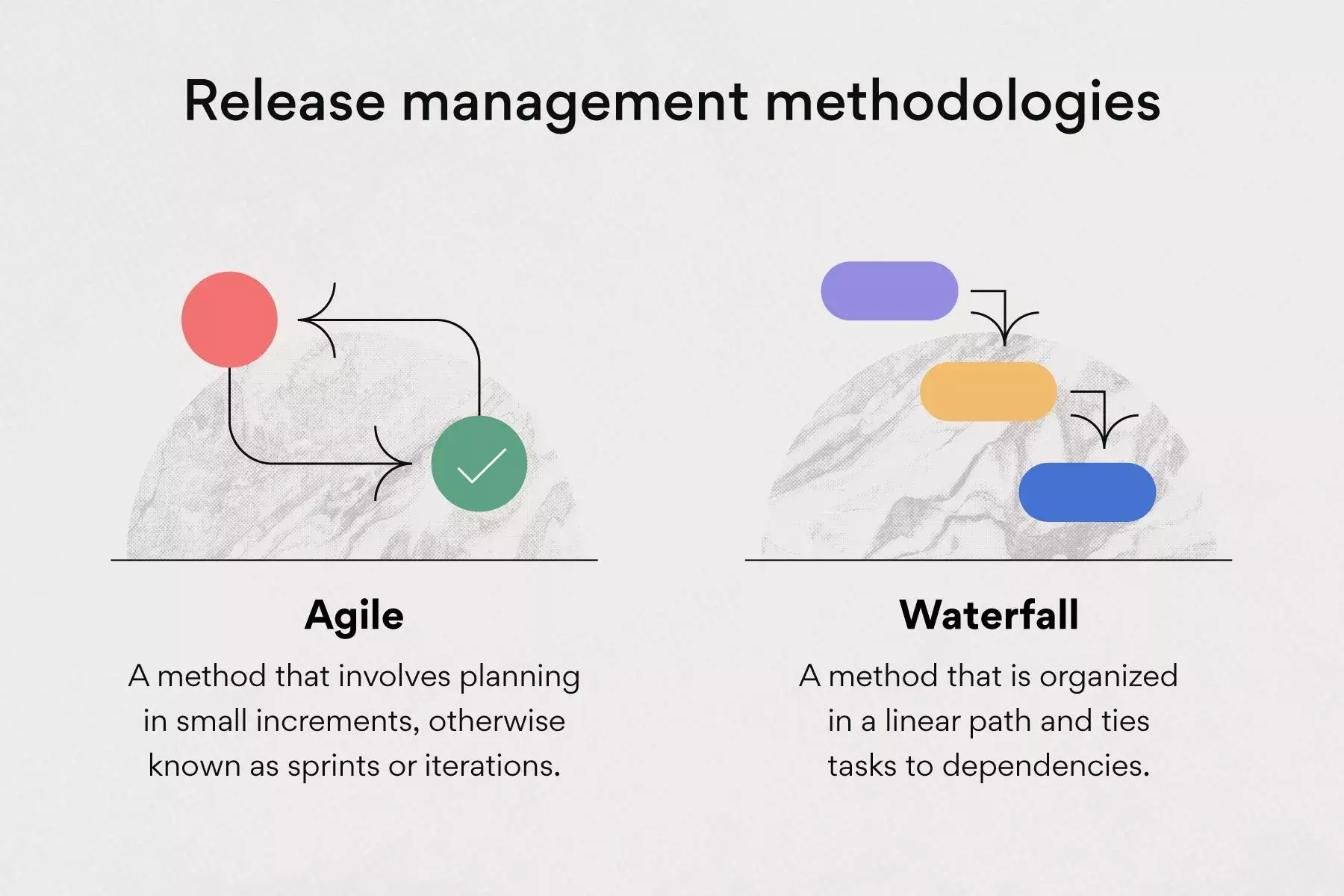
While your software release should follow the five steps above, no matter the method you use, there are a couple of different ways you can go about completing your release. These include Agile development and waterfall development.
While they differ, they yield a similar result. The method you use will depend on the software's complexity and the size of your team.
Agile development
Agile development is a project management method that involves planning a software release in small increments. These increments are often called sprints or iterations. The basic features of Agile management are:
Creating a roadmap
Prioritizing your product backlog
Setting logical goals
Breaking tasks down into smaller sprints
Agile development helps teams manage and complete complex projects, such as software releases, more easily. It's best suited for teams that need tasks broken down into small goals. This is usually the case with smaller teams tackling large projects.
Waterfall development
While somewhat similar to Agile development in that tasks are broken up, waterfall development follows a linear path. This means that each task is tied to a dependency, and tasks that follow won't be started until the previous dependency is complete. Other features of waterfall development include:
Gathering requirements
Planning and scheduling milestones
Implementing the plan
Verifying and testing
Maintaining and improving the plan
Waterfall development is best for larger projects and tends to be more detailed, though either method should result in a successful software launch if implemented correctly. The waterfall development process is best for teams looking for phase-specific tasks.
The methodology that's right for your team depends on its size and your preferred organizational style. When in doubt, try them both to find out which best fits your team's needs.
What are software release management tools?
Software release management tools automate and manage the process of deploying software releases. They help teams schedule, track, and control releases across the software development lifecycle (SDLC) and into production.
Common features include:
Version control: Track changes to code and configurations.
Build automation: Automatically compile and package software.
Deployment orchestration: Coordinate releases across environments.
Environment management: Maintain consistent staging and production setups.
The right tool can help your team with the following:
Improve visibility
Create a work breakdown structure
Make expectations clear
File and track bug reports
Prioritize project changes
Stay on schedule
All of these can not only support a successful software release but also improve your overall team dynamic.
Read: The secret to great group dynamicsRelease management process best practices
Effective release management practices help you minimize risks, improve efficiency, and ensure safe deployment of software updates. Here are five best practices to strengthen your release process.
Establish a standardized release process
A standardized release process ensures consistency, reliability, and efficiency in the software development lifecycle. This practice involves defining a set of procedures and guidelines that govern how releases are planned, completed, and reviewed. By standardizing these steps, teams can reduce errors, manage risks more effectively, and ensure a successful release.
Example
A company might implement a standardized release process by creating detailed documentation on release planning, scheduling, deployment, and rollback procedures. This documentation is then used as a reference for all future releases to ensure that every team member understands the steps involved.
Read: Free SOP template: A standard operating procedures guideImplement automation where possible
Automation in release management refers to the use of software tools and systems to automate various aspects of the release process, from code integration to deployment. Automating repetitive tasks reduces the likelihood of human error, speeds up the release cycle, and reduces downtime.
Example
Consider a scenario where a software development team uses automation tools to handle code integration, real-time testing, and deployment. Once developers commit code to a version control system, automated scripts build the code, run tests, and deploy the successful builds to a staging environment.
Read: How to automate repetitive tasks in five simple stepsFoster collaboration between teams
Fostering collaboration between development, operations, and other stakeholders is vital for a successful release management strategy. Effective communication and collaboration ensure that everyone is aligned on goals, timelines, and responsibilities.
Example
A practical use case for fostering collaboration is organizing regular cross-functional meetings throughout the release cycle. These meetings allow teams to discuss progress, address potential issues, and make informed decisions together.
Prioritize continuous delivery and improvement
Continuous delivery in release management involves regularly reviewing and refining the release process using process improvement methodologies to address inefficiencies, adapt to new challenges, and incorporate stakeholder feedback.
Read: Boost team collaboration with these 11 strategiesExample
An organization might implement continuous improvement by conducting post-release reviews to gather feedback from all involved teams. This feedback is then analyzed to identify areas for improvement, which are incorporated into future releases.
Plan for rollbacks
Planning for software rollbacks involves having a predefined process to quickly revert a release in the event of unforeseen issues or failures. This minimizes the downtime for both end users and the system.
Example
Before deploying a new software update, a team sets up a rollback plan that includes taking snapshots of the production environment and having scripts ready to restore these snapshots if needed. When an issue is detected after the release, the team can swiftly complete the rollback plan to maintain system stability.
Coordinate future releases with release management
Release management is a great process for software developers and DevOps teams to use when releasing a new software product. Not only can it help you catch new release errors in real time, but it can also ensure your IT infrastructure is ready for any updates that come your way.
Take your IT operations to the next level with a release management template.
Create your release management template