Asana AI Teammates: Agents ready to work with your team


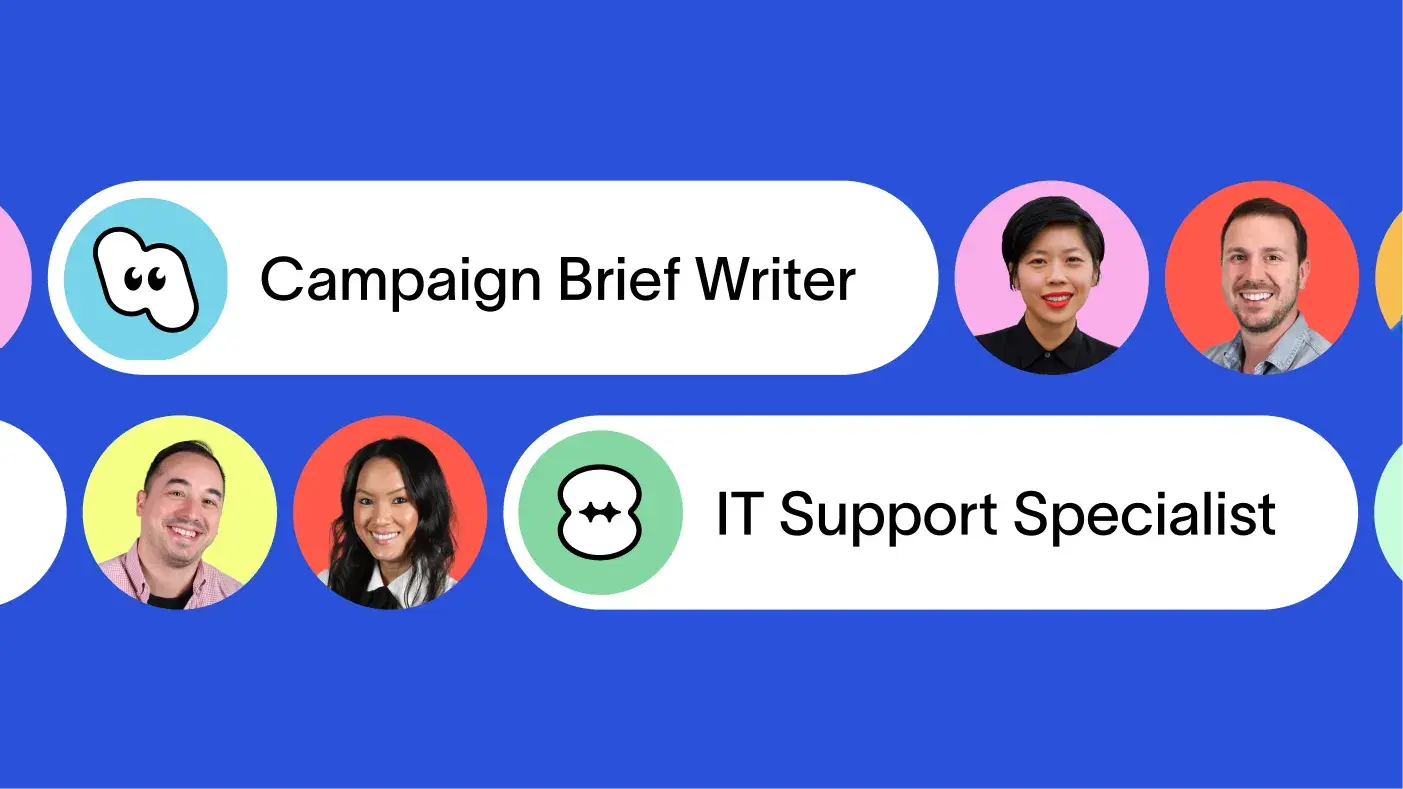
The shift from personal productivity to team-level execution is where most AI falls short. Real work moves through many teams, dependencies, approvals and handoffs—and for AI to actually help, it needs shared context, governance and the ability to execute across business workflows.
Today, we’re announcing new Asana AI Teammates: specialized agents designed to live inside your work, not a side tab.
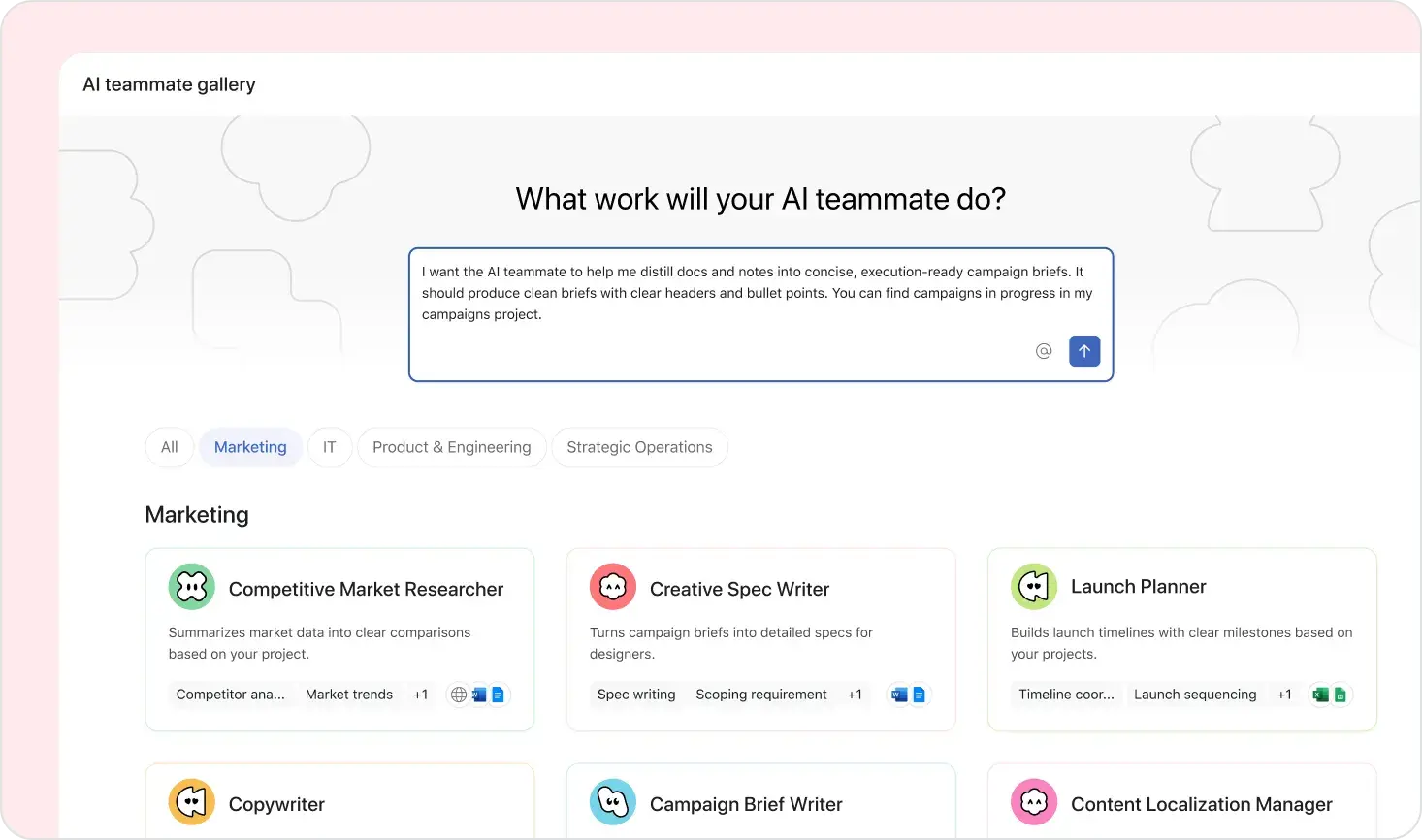
You can hit the ground running with 21 out-of-the-box agents for Marketing, IT, and Ops—or use our no-code builder to design your own custom Teammate from scratch. Either way, you have powerful new side kicks embedded in your team
What are AI Teammates?
Collaborative AI in action
Our AI Teammates handle everything from daily tasks to the complex, coordination-heavy work that can stall projects. Here's four worth noting right now:
Marketing: The Campaign Brief Writer
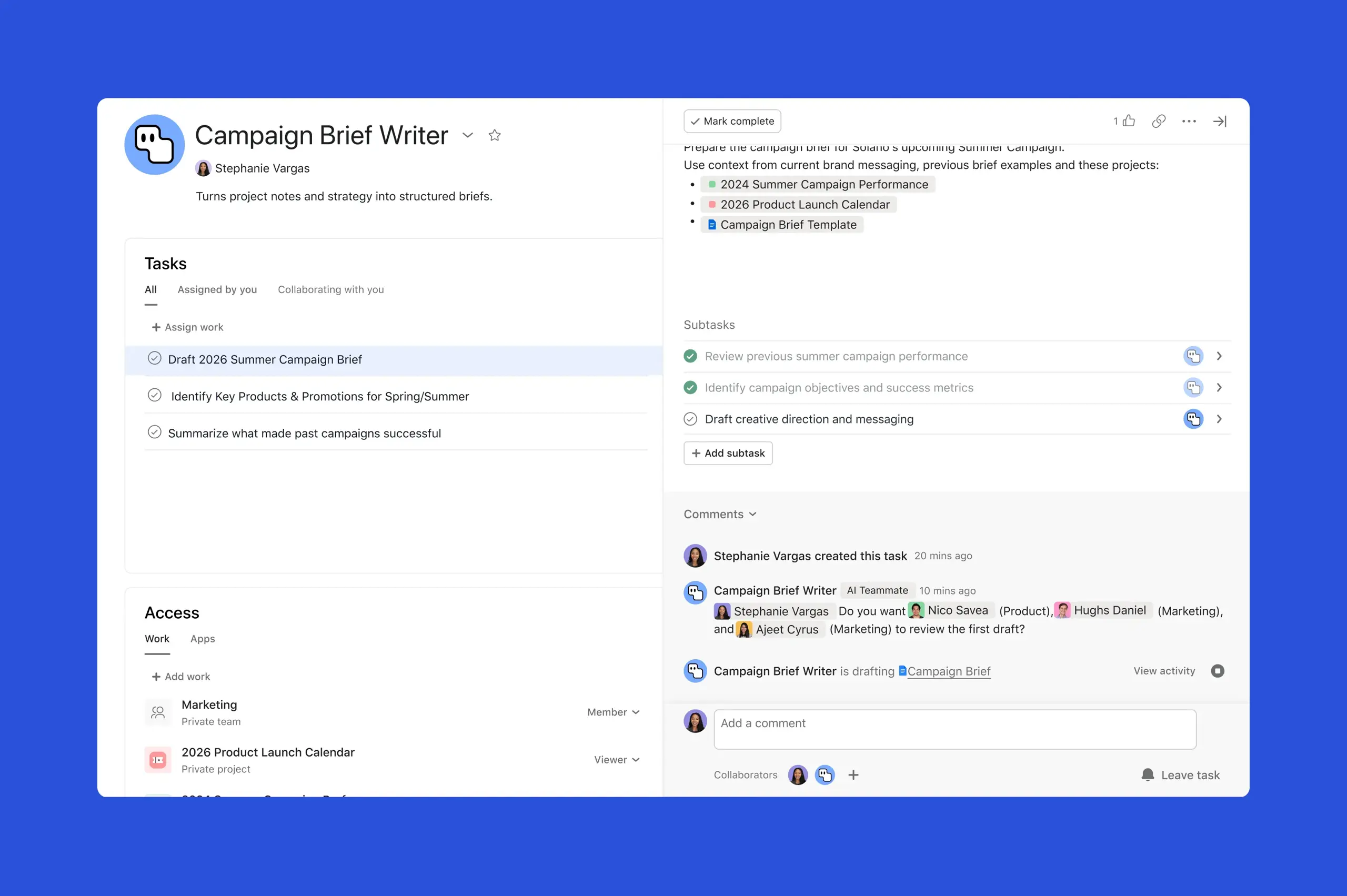
Projects stall for weeks because strategy is scattered across Slack threads, PDFs, and meeting notes. Managers spend their time manually merging this data just to get a designer started.
The Campaign Brief Writer scans your unstructured data (transcripts, docs, and threads) to build a structured, execution-ready brief. It identifies missing requirements—like a missing KPI or target audience—and flags those gaps to you before the brief is finalized.
The Result: You collapse the "idea-to-design" gap from weeks to minutes. Plus, every asset produced is aligned with the original goal, eliminating expensive revision cycles.
Strategic ops: The Workflow Optimizer
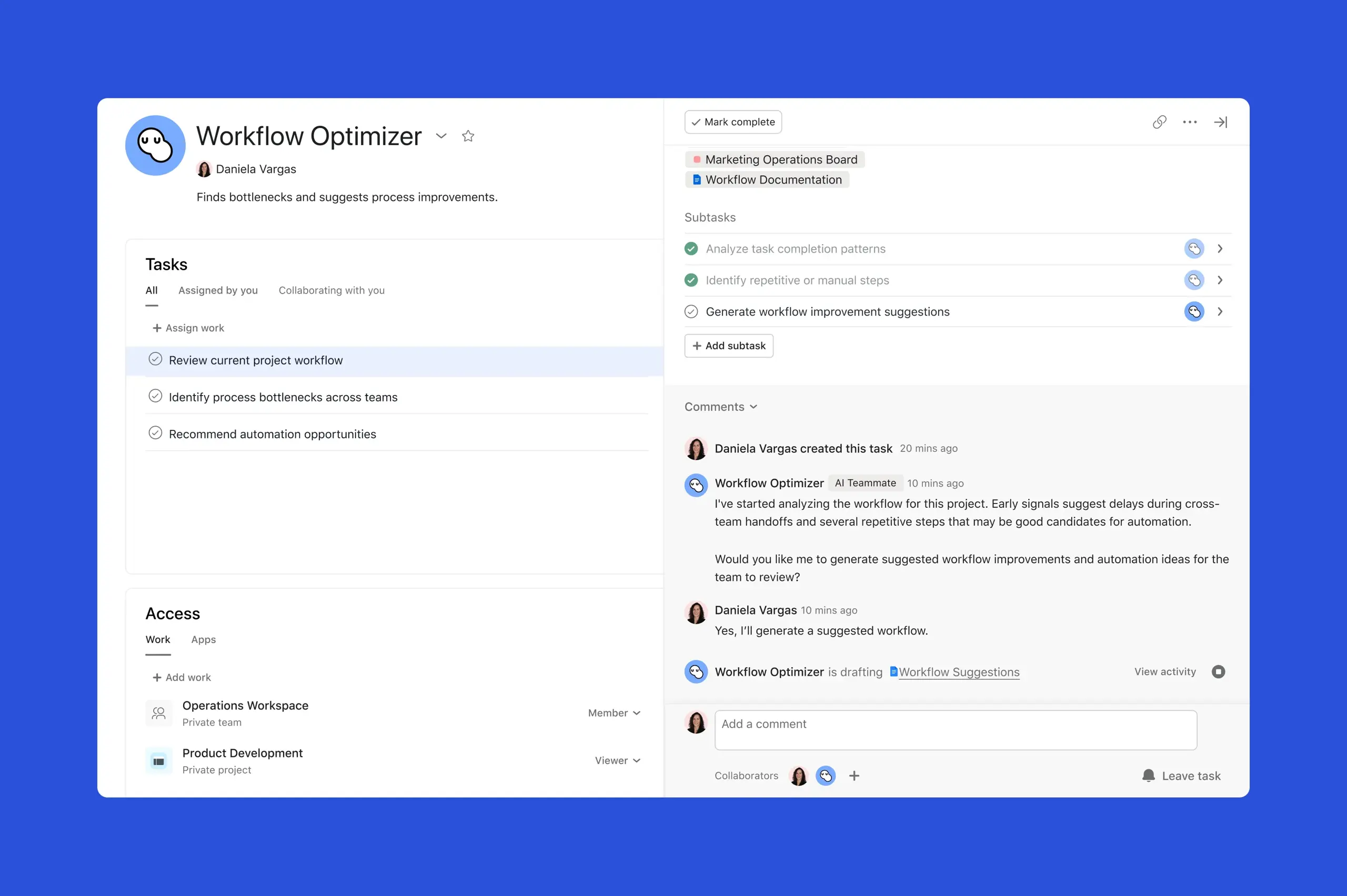
Most teams treat slowdowns as a people problem—more meetings, more check-ins. The real culprit is usually a redundant approval loop or a manual handoff buried deep in a process nobody has questioned in a while.
The Workflow Optimizer audits the timestamps of every handoff in your project history to find exactly where work sits idle. It doesn't just flag the problem—it builds the specific automation to fix it, like automatically re-routing an approval when a stakeholder goes dark.
The Result: Instead of guessing why legal review takes three days longer than it should, you have a blueprint to fix it.
IT: The Compliance Specialist
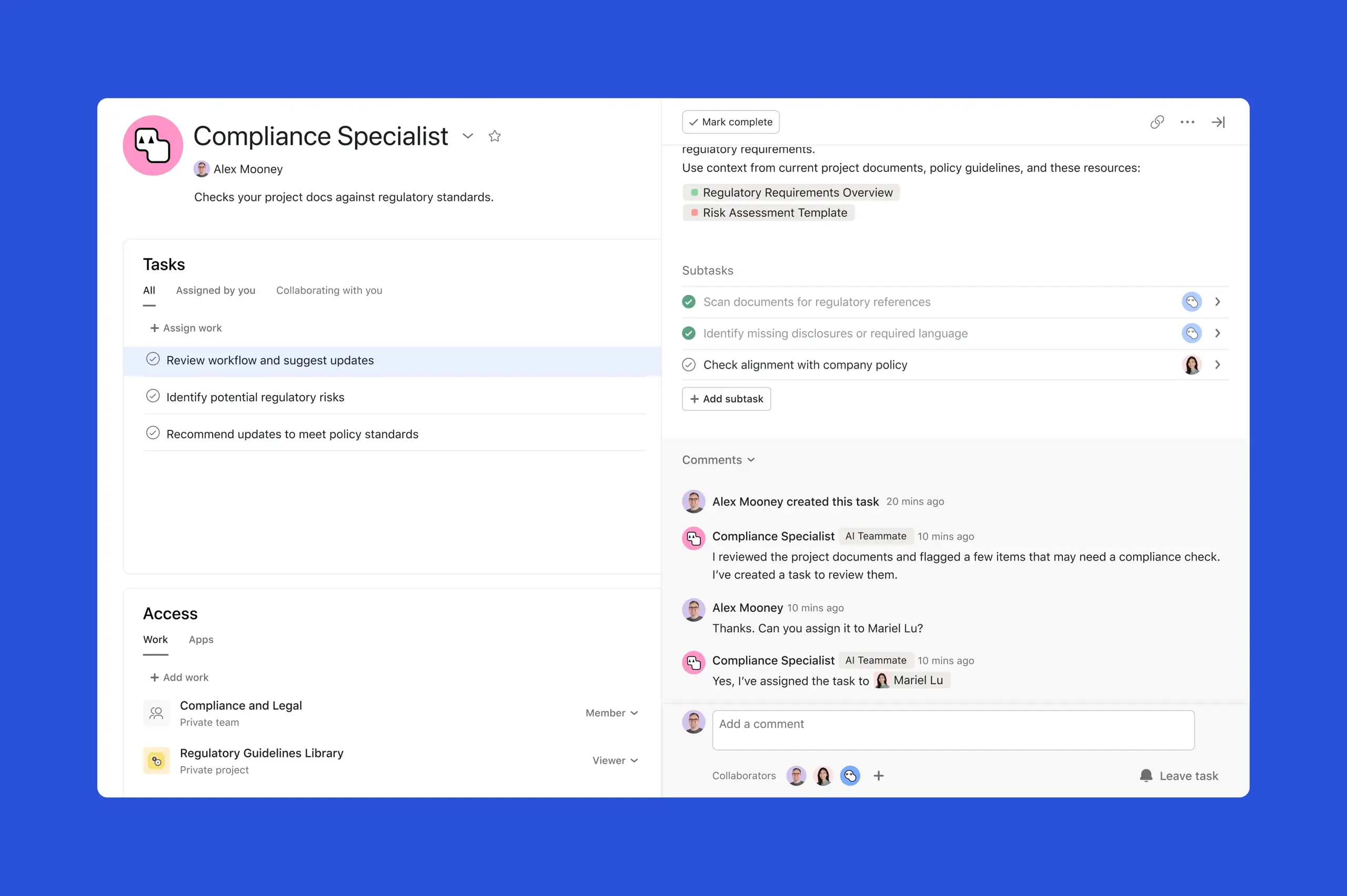
Compliance is traditionally a "fire drill" at the end of a project. If you miss a security tag or include unencrypted data, you don't find out until the final audit—which can kill a launch date and cost millions in risk.
The Compliance Specialist acts as a real-time validator. As work happens, it checks every task and attachment against your pre-set SOC 2, ISO, or internal security standards. If it detects a violation, it alerts the owner and creates a remediation task instantly.
The Result: Compliance stops being a bottleneck and becomes a guardrail. IT leaders can finally say yes to faster, more decentralized execution—because the guardrails are built into the work, not dependent on human memory.
For any team: The Launch Planner
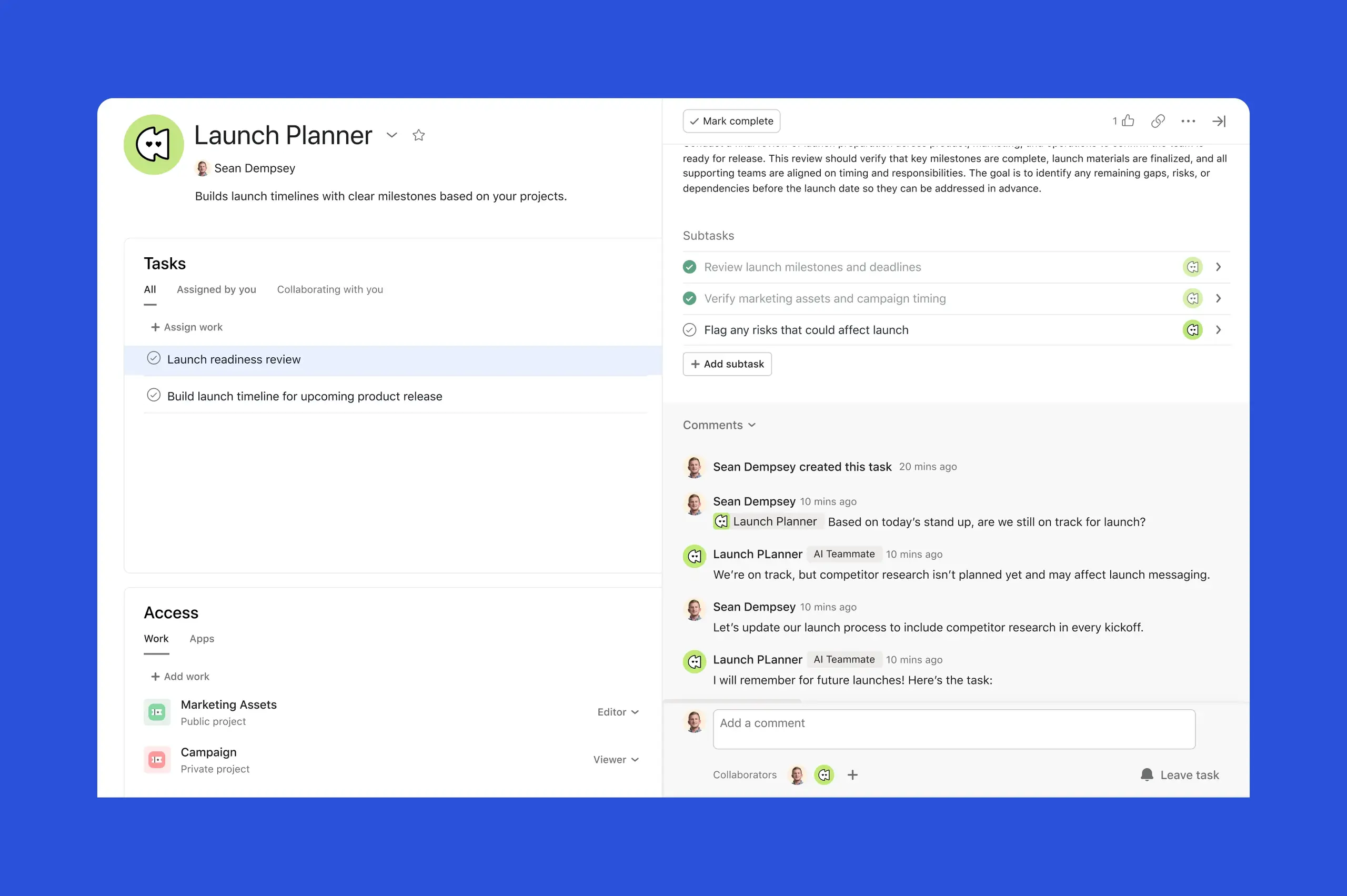
Launches miss deadlines or fail due to invisible dependencies. Humans can't easily track how a 2-day delay in a beta fix in Engineering will ripple down to break a press release announcement scheduled for three weeks from now.
The Launch Planner maps the entire multi-departmental ecosystem. It calculates the critical path across the Work Graph, identifying how a slip in one department creates an issue in another that isn't even in the same project view.
The Result: Predictive risk management. It doesn't just show a timeline; it predicts the impact of delays. If a dependency is threatened, it automatically alerts both owners and proposes a re-aligned schedule. You stop reacting to crises and start preventing them before they hit the calendar.
The full list of AI Teammates available at launch include: the Campaign Brief Writer, Creative Spec Specialist, Launch Planner, Copywriter, Competitive Market Researcher, Content Localization Manager, Brand Auditor, Pricing Strategist, Status Reporter, Business Case Builder, Decision Tracker, Workflow Optimizer, Data Quality Manager, IT Support Specialist, Trend Analyst, Compliance Specialist, Onboarding Assistant, Vendor Evaluator, Spec Reviewer, Bug Investigator, and Sprint Coach.
Smarter teamwork, not just smarter prompts
Most AI tools are single-player: a private conversation between one person and an LLM. But work doesn't happen in a vacuum. When AI lives in a private tab, the insights stay there too, creating new silos instead of breaking them down.
Asana AI Teammates shift teams from individual prompts to super-charged execution. Here’s how:
Multiplayer by design. They live in the project, not a private chat. When one person shifts a priority, the AI Teammate updates the roadmap for the whole team.
Zero coordination overhead. By absorbing the "coordination tax"—the chasing, status pings, and manual handoffs—AI Teammates drive higher throughput with less rework and manual orchestration.
Institutional memory. Knowledge stays in the system. As your team gives feedback, the AI Teammate gets smarter for everyone, preserving context as your organization scales.
Governed execution. Innovation shouldn't create risk. These agents operate within your existing permissions and security rules—no new frameworks or guardrails to manage.
After testing AI Teammates with more than 200 organizations in our Beta program, the results show a clear appetite for our collaborative approach:
Deep trust. 93% of AI Teammates were granted full edit access, not view or comment only. That level of trust happens when agents aren't just "chatting" but are actively coordinating work toward shared goals.
Shared resources. Teams quickly moved away from individual agents toward shared Teammates that handle everything from IT requests to strategic planning across departments.
Measurable velocity. Teams finished work 2x faster. Tasks managed by collaborative AI Teammates were 3.2x more likely to have a clear owner and 2.6x more likely to have a defined deadline.
Faster execution is amazing, but clearer ownership, better deadlines, more visibility? That's what takes company growth and success to the next level.
How Morningstar transformed strategic analysis
When Morningstar's project management team faced the daunting task of analyzing historical data for a complex project, they knew they were looking at weeks of intensive work.
Enter their AI Teammate.
What happened next helped change how the global financial services firm approached this type of work: "A huge job that would have taken a human a monumental amount of time—about a week or two—the AI Teammate was able to just go through it in hours. Boom,” says Alina Lamy, Senior Project Manager in Morningstar's Retirement Group PMO.
But speed was just the beginning.
The quality and depth of insights delivered exceeded expectations, revealing hidden patterns in their data that informed critical business decisions. For Morningstar's CIO Laura Kohl, this represents something much bigger than task automation: "Asana AI Teammates helps us to securely unlock the institutional knowledge within our work data, generating data-driven insights that inform critical business decisions. In one use case, it completed weeks of complex research in hours,” Kohl says. “This helps to evolve how our teams operate and supports our ability to deliver results at scale."
How Human-I-T scaled quality and operations with AI
When Human-I-T processes hundreds of devices each day, accuracy is everything. Staff enter technical specs—RAM, CPU models, storage—across hundreds of tasks, and when data entry is inaccurate, it doesn't just create one bad record. It breaks downstream reporting, routing logic, and the integrity of the entire pipeline. Manual review used to take two hours a day, and the team still couldn't catch everything.
That's where their AI Teammate came in.
The results reshaped how the nonprofit manages quality at scale: "We went from two hours of manual portfolio review down to 30 minutes. Our AI Teammate runs 14-plus hours a day, autonomously, processing the full volume of devices without human intervention," says Jean Favela, IT Manager at Human-I-T. "But the real impact isn't the time—it's the quality. We eliminated the class of errors that was breaking our downstream reporting. Now I can assess every device in our organization with confidence. That's something that was simply impossible before—not difficult, impossible."
And that was only the first chapter.
Human-I-T's leadership team now uses AI Teammates as personal strategic assistants every day—creating tasks, summarizing work, and generating follow-ups like AI-powered executive assistants. For CEO Gabe Middleton, the impact goes far beyond any single workflow: he describes the strategic planning capabilities as "blowing my mind" and credits AI Teammates with bringing "major breakthroughs to our operations." These deployments are the first layer of what Human-I-T is building toward—a fully AI-first operations model, with plans to extend intelligent automation to other high-volume, error-prone workflows across the organization.
Start using AI Teammates today
The new AI Teammates are available today as an add-on to Starter, Advanced, Enterprise, and Enterprise+ plans. Contact your sales rep to get started.
(Self-service coming soon.)